
Source
of the photo (edited)
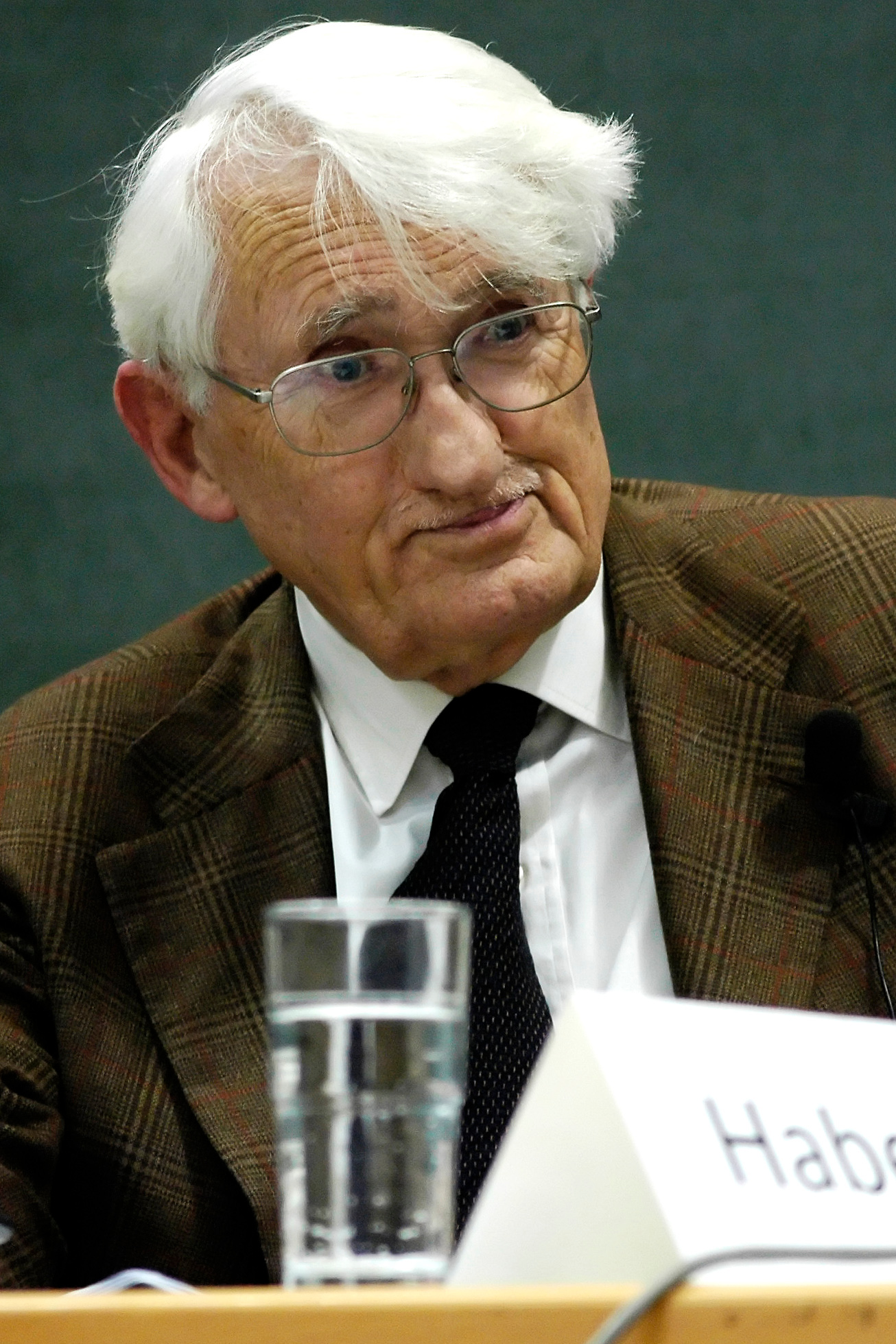
On 14 March 2026, Jürgen
Habermas, one of the greatest German thinkers, died, 96 years old. Habermas was
a philosopher and sociologist who had a big influence on philosophical and
political discussions in Germany and outside Germany. Only this fact is a
sufficient reason to devote a blog to him. But there is also another reason:
Habermas was one of those philosophers whose writings have much influenced my
philosophical thinking, particularly during the first years of my intellectual
development. Habermas has written about 50 books and I have some 20 in my
library, especially those written in his earlier years. For it’s true, over the
years I lost contact with Habermas’s philosophy. However, without his work, my
philosophical development would have been different. In this blog it’s
impossible to do justice to Habermas, so I’ll restrict myself to some notes on his
influence on my personal road in sociology and philosophy.Currently Habermas is chiefly known as a political philosopher who stands for the freedom of speech and opinion, for democracy and open discussions and who is an advocate of the European Union, and some in memoriams are mainly devoted to Habermas’s contributions in this field. However, when I went to study sociology at the end of the 1960s, there was a fierce discussion going on in the social sciences about the right method for studying human actions, the so-called “Positivismusstreit” (positivism dispute). The essence of this discussion was whether sociology should use the same method as the natural sciences, the method of explanation, or whether there was a special method typical for the social sciences: the method of Verstehen (understanding). As such this discussion was already rather old. The problem was first formulated by Wilhelm Dithey (1833-1911), who elaborated the philosophical characteristics of the method of Verstehen, while later Max Weber (1964-1920) elaborated Verstehen for the social sciences. Then this discussion faded away but in the 1960s it revived, especially thanks to the writings of Hans Albert and Jürgen Habermas. While Albert defended the view that the method of explanation applies to all sciences, including the social sciences, according to Habermas – and here I must simplify his ideas very much – the natural sciences and the social sciences are led by different “knowledge interests”, and as a consequence they require different methodological approaches: Explanation for the natural sciences and Verstehen for the social sciences. Habermas discussed his ideas about method especially in his On the Logic of the Social Sciences and the ideas about knowledge interests in his Knowledge and Human Interests. I read both books in the original German, and although they have been written in a difficult and often not very clear German (and although my German was yet quite basic then) I read them with interest and they convinced me. It is here that you find the basis of my ideas about the method of Verstehen that I later developed in my PhD thesis. These writings by Habermas didn’t only have a big impact on my intellectual development, but they led me also to Karl-Otto Apel, who soon would have a yet bigger influence on my thinking than Habermas (see this blog). Although I kept reading Habermas’s books, gradually my attention switched to works by Apel, Georg Henrik von Wright, and others.
Habermas’s epistemological thinking didn’t stop. On the contrary, it just had started and in his Theory of Communicative Action (1981) he further elaborated the view – already discussed in On the Logic of the Social Sciences – that no theoretical thinking – so including the theories of the natural sciences – can be objective, independent of what humans value. Moreover, all theoretical thinking is based on the mutual human understanding of what such theories are about. Actually, so Habermas, there are two levels of thinking: theoretical thinking, so scientific understanding, and commonsense thinking, so human understanding in daily life. Habermas called the former level of thinking and understanding level 1, and the commonsense level – the way we understand in daily life – level 0. This distinction plays an essential part in my PhD thesis, and it brought me the idea that there are two levels of meaning related to these levels. I called them respectively meaning 1 and meaning 0. With the former I refer to the meaning a scientist gives to an object, either physical or social in character. It is the scientist’s theoretical interpretation of reality. With meaning 0 I refer to the meaning the people who make up social reality give to the social reality or to parts of it themselves. It is their interpretation of their own lived reality. For me, this distinction between meaning 1 and meaning 0 plus Habermas’s and Apel’s idea of knowledge interests is the basis and with it the reason of the idea that we need a special method in the social sciences to investigate actions: the method of Verstehen.
After the publication of his Theory of Communicative Action, questions in the field of philosophy of science faded into the background in Habermas’s work, and gradually I stopped following him. While Habermas involved himself increasingly in political discussions and defended the ideas of the Enlightenment like freedom of speech and opinion, democracy and open discussions and became also an advocate of the European Union, I went more and more in the direction of the analytical philosophy of mind and action, and I wrote my PhD thesis and articles on themes in that field (see my website). After some time, I stopped reading Habermas’s books, too. It’s only later, especially under the influence of the outbreak of the war in Ukraine and the ideas of philosophers from the 16th and 17th centuries like Montaigne and Spinoza that again I began to give more attention to my political ideas in my writings, ideas that had always, already since my study in sociology and before, guided my political and philosophical choices, sometimes openly, sometimes in the background).
My thesis led me definitively away from Habermas. However, this didn’t happen because I came to disagree with his ideas. Far from that, but my thesis made me take new paths in philosophy and discover new philosophical fields. However, no doubt, without Habermas I would have failed to see the right signposts. Without Habermas my road would have been different. With his death, a philosopher and sociologist has gone who clearly stood for the ideas of the Enlightenment, in the sciences, in the humanities, in politics and in daily life; ideas that have been under attack already since Spinoza formulated them. Today, we must still defend them, but now without Jürgen Habermas.

No comments:
Post a Comment