Share on Facebook

Monday, October 10, 2016

Frame analysis


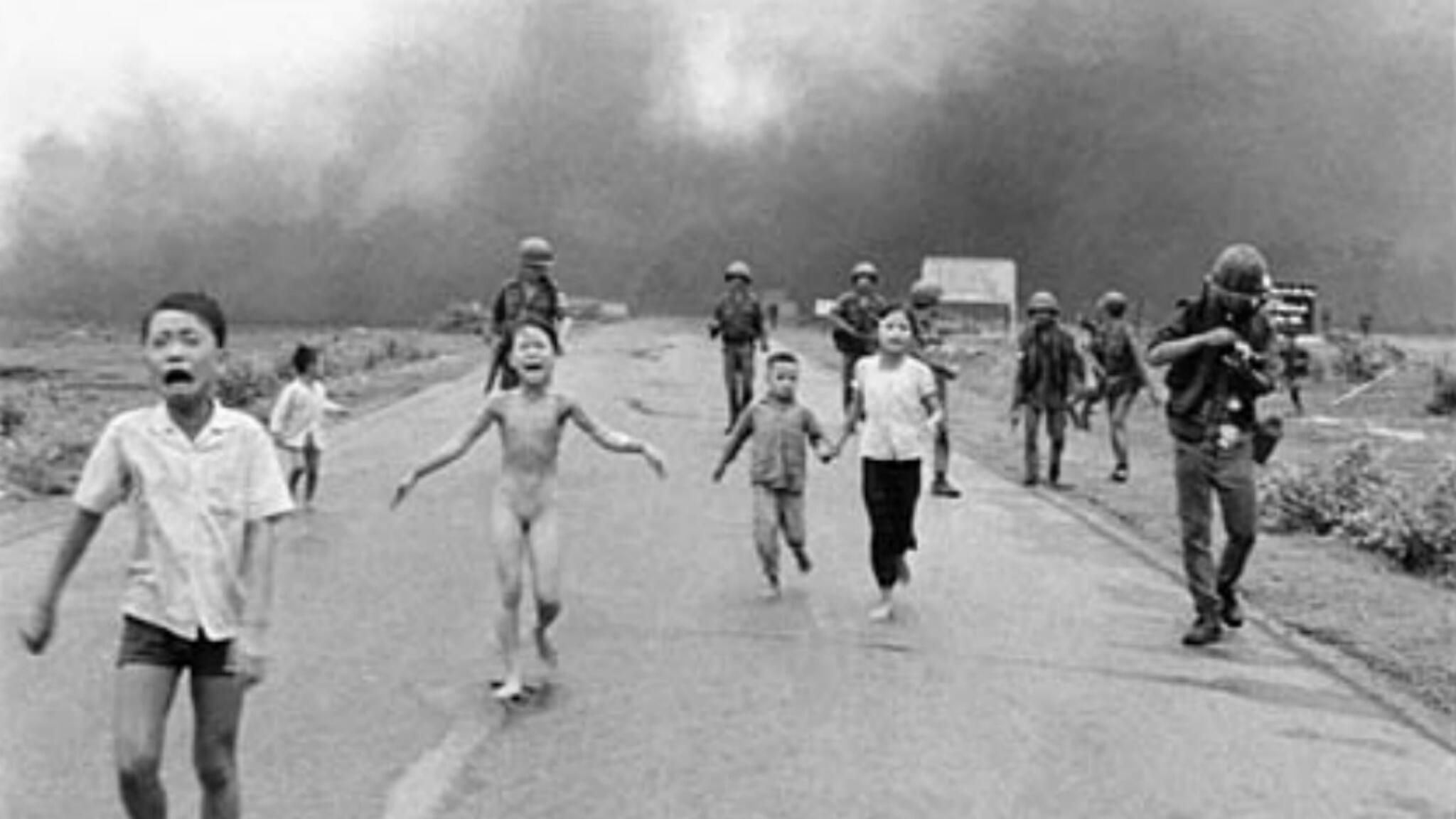
Photographic frames are actually nothing but instantiations of what are called “cognitive schemas” elsewhere in these blogs: schemas that help organize what you see; that let out what is unimportant; and bring to the foreground what is relevant for you. It’s a term that is especially used in linguistics and psychology. The philosopher Antonio Damasio calls them “maps”, while the term “frame” is common in sociology for the phenomenon (although the word is also often used in psychology). The classic book on “frame analysis” in sociology still is the one by Erving Goffman with the same title, published in 1974. Maybe the subtitle of this book describes best what framing is about: The organization of experience. The photo of the napalm girl discussed by me last week shows well how this works.
Goffman’s Frame Analysis is quite a thick book (nearly 600 ages) and in my blogs I can’t do justice to it, but let me pick a few elements from it. As we just have seen, for Goffman framing is a matter of organizing experience. More exactly, for him framing is a method we use for defining a situation we are involved in; so it is a way to give it an interpretation. He sees frames as “principles of organization which govern events – at least social ones – and our subjective involvement in them” (pp. 10-11). For instance, suddenly I hear a bang and I see people running. I wonder what is happening and what I have to do. Is it an explosion? Is it a terrorist attack? Does it come from the exhaust pipe of a car? Depending on how I interpret the bang, so how I frame it, and the reason I am there – am I a passer-by, a policeman or do I live there? – I decide what to do: Nothing, or going to the site for getting more information, calling for help, running away, etc. A frame is individual, as Goffman says a few pages further, it is subjective and, as I want to add – but certainly Goffman says it elsewhere in his book – it has consequences for our behaviour: from doing nothing and accepting as it is till taking action.
Most framing doesn’t happen explicitly and consciously. Goffman’s explanation is a bit complicated, so let me say it in my own words: As soon as someone recognizes a situation, he or she automatically applies a framework or schema of interpretation. Since everyone has gone through a shorter or longer period of education and internalization, initially he or she falls back on the concepts and standard interpretations typical for his or her culture when interpreting an event or situation. Goffman talks here of “primary frameworks”. So if we see someone taking a book from a shelf in a certain type of building and giving a sheet of paper to another person, we automatically apply the framework “buying a book” (p. 21; the example is mine).
Primary frameworks can be of two kinds, so Goffman: natural and social. Again I want to use my own words. A framework is “natural” – not to confuse it with the term “natural frame” as I used it in my blog last week – if it is purely physical and if its meaning does not depend on the willful agency and intentionality of other people. On the other hand it is “social”, if it gets its meaning from the wills, aims and intentions of others. So a certain object is for us just a round thin piece of copper if considered in the natural way or a five-cent piece if interpreted within a social framework. (cf. pp. 21-22) Dealing with objects within a natural frame requires instrumental action, while within a social frame it involves rule-guided action.
By applying frames we constitute what we see and experience. Often frames are shared among individuals in the sense that they apply more or less the same frames to the same situations or events. Then all share an understanding of what it is that is going on and what everyone is doing, and then the frame concerned is “effectively correct” (cf. p. 301). In this way shared frames make that people stick together so to speak.

Reference: Erving Goffman, Frame Analysis. An Essay on the Organization of Experience, Boston: Northeastern University Press, 1986 (my edition).

Framing the world


Photos give a representation of reality. At least many people think so. But do they really do? Recently I had a photo exhibition in my town in which I tried to make clear that they don’t. The photos showed landscapes, city views and the like but all had, what I would call, “natural” frames. Often photos on an exhibition are put in wooden, plastic or metal frames, but I had taken the photos that way that the frame was in the photo itself, for example because I had taken a photo through a window together with the window frame (see for example the photo above). Of course, you cannot capture the whole world in one picture, so a photo must have an edge, but what many people don’t realize is that just the edge makes that the photo doesn’t give an objective view, but that it is subjective because there is an edge. The edge directs the contents of the photo and makes that it presents a perspective on the world and that it is a subjective interpretation of the world. In other words, the edge of a photo functions like a frame. In order to stress this and to make the viewers of my photos aware of it, I had the photos on my exhibition provided with natural frames.
In sociology, a frame is a set of concepts and theoretical perspective on how we perceive reality. Framing is the social and perspectival construction of a phenomenon. The frame tells us what is valuable and it excludes what isn’t, because we don’t find it interesting; because it distracts; because we want to ignore it; and so on. Actually in psychology it is the same but the difference is that psychology concentrates on other themes than sociology does – which just makes that the sociological and psychological perspectives are also frames! – Prejudices and testimonies are instances of such frames. Prejudices are ways to order the world and to pigeon-hole persons and phenomena. And when an accident has happened and a policeman asks the witnesses what they have seen, he will hear different stories, for each person interprets what took place from a different point of view.
Framing can have quite extreme and improbable effects. Take this psychological experiment:
Imagine you are asked to watch a video in which six people – three in white shirts and three in black shirts – pass basketballs around. While you watch, you must keep a silent count of the number of passes made by the people in white shirts. At some point, a gorilla – actually a man in a gorilla suit – strolls into the middle of the action, faces the camera and thumps its chest, and then leaves, spending nine seconds on screen. Would you see the gorilla? I think you’ll say “yes” but actually half of the test persons did not: Their frame of attention was counting the passes which made that much what didn’t fit this frame was excluded from their attention, including the gorilla facing the camera. (source: http://theinvisiblegorilla.com/gorilla_experiment.html)
To take yet a photographic example: Recently there was much to do on Facebook about the famous photo of a little Vietnamese girl hurt by napalm and fleeing from her village that had been bombed with napalm (https://geschotenindeoorlog.files.wordpress.com/2013/10/vietnam-napalm-girl1.jpg). The photo is very dramatic. However in order to emphasize the drama – and with right, I think – the photographer had cut off the right part of the photo, which showed a relaxed soldier looking at the camera in his hands (https://pbs.twimg.com/media/Bj5h_YaCIAE2Jom.jpg:large). If the photographer wouldn’t have cropped the picture, it would have been less dramatic: A matter of framing.
Compared with the photo of the napalm girl, my photos with natural frames are not dramatic. Their contents is innocent. However, they show what you can do with a frame, and what we in fact all do every time when we look at something: Frames stress what we want or expect to see, just as in my photos the frames emphasize landscapes and their beauty, or the dullness of a rainy day. But actually we don’t know what happens outside the frames and where they have been taken.

My photos with natural frames can be viewed here:
https://www.flickr.com/photos/photographybytheway/albums/72157657516004509

Monday, September 26, 2016

When science fails


Progress in science is a matter of developing theories that are better than the existing ones. A new theory is better if it explains phenomena that the old theory fails to explain, although they are within its range and should have been explained by it. Or the new theory gives a more plausible and simpler explanation of the facts. Of course, with the help of some additional suppositions it may be possible to give the old theory a new or broader basis, but with each additional supposition the old theory becomes more complicated and by that more unlikely. The rule of thumb in science is the simpler the better and generally it works that way. So, many old theories have quitted the scene in exchange for new ones that played their parts better. Now we know that the sun doesn’t orbit around the sun but that the opposite is the case. We know that there is no ether that fills empty spaces but that a vacuum is really possible. And we know now that life cannot originate from dead matter. How progress works in science has been summarized by Karl Popper in a well-known scheme:
P1 > TT > EE > P2
In words: If we have a problem that we can’t explain with the old theory (P1), we revise it or develop a completely new theory (TT). Then we perform experiments (EE) in order to test our new ideas, and if the new ideas are confirmed, the old theory has been improved or replaced in favour of the new one. However, usually we see then new problems (P2) and the cycle starts again. Since here in my presentation we start with the idea of a theory that appears to have mistakes, we might describe the process of theory evolution also this way:
TT1 > P > TT2 (tentative) > EE > TT2
Since TT2 is better than TT1 Popper talked here of error elimination. This implies that actually the old theory has failed, because it contained mistakes. But this is how scientific progress works and there is no other approach. And often it is so that the old theory has been used for a longer or shorter time to everyone’s satisfaction, despite its mistakes.
TT1 can also fail for another other reason: Not because it has been replaced by a better theory but because it is bad science. That’s what we have seen in my last blog. If we look at the first scheme, then the trouble is not that P that can’t be explained by TT but we think that TT has explained P but the explanation is false. It is because the tests that seem to substantiate TT have not been well done. So there is a failure in the performance of EE. This can happen by accidental occurrences, but usually it is so that the methods of investigation have not been well applied by ignorance, negligence, lack of money or something like that, or in order to please the one who pays the investigation or even by fraud. In other words, the tests failed because of bad science. If it happens now and then it’s a blot on science. However, if it happens too often and on a large scale, sooner or later it will lead to a crisis. Then the schemes are no longer as shown above but they have become:
P1 > TT > EE > P2
and
TT1 > P > TT2 (tentative) > EE > TT2.
When the failures come to light we have a crisis in science and the schemes as just represented stand for regress in science. And that’s what we see now in social psychology. From a methodological point of view the rules are simple: Besides a strict and correct application of the methodical prescriptions any investigation has to be replicated, if possible by other investigators in another setting and with another set-up. But often there are many reasons not to replicate an “old” experiment. Practical reasons, financial reasons and human reasons, for little credit can be gained by affirming what has already been said by others (and if the original investigation has been well performed, this will be the result). But a crisis in social psychology does not hurt only social psychology itself (or any other science that is hit by such a crisis, as the case may be), but it has wider consequences. Results are applied. Convinced that the psychological investigations have been well done, therapists have put their outcomes into practice. In philosophy they have affected the view on man. Etc.
The key question is how it could come that far. If we don’t give it an answer it can happen again, in psychology and elsewhere. There is a name for the present problem: Replication crisis. It’s a name that points already to its solution. But who will be prepared to tackle the problem, as usually it is so that it doesn’t bring much to you if you do old wine in new bottles?

Monday, September 19, 2016

Keep smiling


When we intentionally make a smile on the face we tend to feel as if we really smile and it is more likely that we feel amused by a joke or a cartoon. When we make a sad facial expression we tend to feel sad. When we straighten the back we tend to feel pride and when we look to the ground we tend to feel humble. That’s what I wrote in a blog six years ago. Do you believe it? I did but I don’t anymore.
Take the case of intentionally smiling which should make you feel better. This so-called facial feedback hypothesis had been discovered in 1988 by the German psychologist Fritz Strack and his team. The investigators took 92 students who had to put a pencil either between their teeth (which made them smile) or between their lips (which made them pout) and then judge funny cartoons. In the former case they found the cartoons funnier than in the latter case. How this mechanism worked was not clear but it was applied by many behavioural therapists. However, in order to ensure that research results are correct – for instance that they are not caused by factors not studied in the investigation – any research should have to be repeated. Therefore, recently, at the instigation of Strack, seventeen laboratories in the USA, Canada and Europe performed replication tests. Maybe that it wasn’t known how the facial feedback hypothesis worked should have been a warning, for it came out that it had to be refuted. How pity, for I used the effect sometimes when I felt tired at the end of a long bike ride with still many kilometres to go: I simply straightened my back, lifted my head, looked around and smiled. This gave me again the mood to go on with a decent speed. It was not that I was less tired then, but it felt so.
The facial feedback hypothesis is not the only result in social psychology that recently has been rejected after replication. To take another case mentioned in my blogs: We tend to walk slower, when we see old people passing by, or also when we have read a text about old people with words like old, slow etc. Also this psychological classic appeared not to be true. Even more, when investigators tried to replicate about hundred of such “facts”, two third could not be validated. Combined with recent cases of research fraud we can say that social psychology is in dire straits.
What does all this mean? The refuted investigations helped build a certain philosophical image of man. Psychologically they painted man as a kind of physical dope that is the outcome of hidden mechanisms that work independent of the will: If we are funny, happy, helpful, sad, angry, nice etc. we are often so despite ourselves. Now I don’t want to deny that man is the result of hidden processes in some way. Too much points to the fact that most of what we do is “decided” on an unconscious level, but apparently how this takes place is not as simple as suggested by the now rejected psychological studies. Apparently we are not the kind of automatically behaving persons we had come to think we are on the basis of the rejected studies. Man appears to be structured in a different way and – let me formulate it carefully – there might be more elbow room for a free will than the studies suggested. This may especially be so, if we accept that there need not be a contradiction between the fact that what we do is prepared by unconscious processes within us and the idea that we have a free will, as I have explained before.
Nevertheless, when I make a bike tour and I become tired, I still can decide to make a smile, for whatever the investigators say, to my feeling it works. Already simply the idea of smiling cheers me up. Maybe it is a kind of placebo-effect and it works because I think that it works, and just that is what makes that I am going to ride better. But my adagio is: If it works, it works. So, I keep smiling. Why not you too?

Monday, September 12, 2016

Wittgenstein and the concept of rationality

Countertenor Philippe Jaroussky and his ensemble Atarserse in the TivoliVredenburg concert hall

In my last blog we have seen that we can act in a rational way although what we do is not necessarily rational according to the utility theory in economics. But what is rationality? On the Internet, you can find many definitions, some better, some worse, but let me say it this way: Actions are rational if they contribute to our present purposes. This is rather vague and I could add yet a phrase like “in the best way”, but I think that the essence of what I mean is clear. So, if I want to go from my house to the TivoliVredenburg concert hall in Utrecht, I can take the train, my car or my bike. Each of these means is rational in view of the purpose of going there. Moreover I can add some criteria, like “in the cheapest way”, “as quick as possible”, “conveniently” or what more, and then I can make my definite choice. So in order to make our choices, we often have to add secondary purposes. Seen that way, it is not obvious that our purposes are economic in the first place. It’s quite well possible that our choices are not rational in an economic sense, although they are rational of a kind. It’s a thing that economists – and politicians as well – often forget and it’s why Daniel Kahneman, by showing this, received the Nobel Prize. I can say it also in this manner: Rationality is not an intrinsic property of our actions. It depends on the context.
Although Wittgenstein didn’t develop an explicit theory of rationality, just that rationality is context-dependent, becomes clear from his work, especially if we look at his idea of language game. In his Philosophical Investigations (PI) he writes: “Consider for example the proceedings that we call ‘games’. I mean board-games, card-games, ball-games, Olympic games, and so on. What is common to them all? ... [I]f you look at them you will not see something that is common to all, but similarities, relationships, and a whole series of them at that. ... Look for example at board-games, with their multifarious relationships. Now pass to card-games; here you find many correspondences with the first group, but many common I features drop out, and others appear. When we pass next to ballgames, much that is common is retained, but much is lost.—Are they all ‘amusing’? Compare chess with noughts and crosses. Or is there always winning and losing, or competition between players? Think of patience. In ball games there is winning and losing; but when a child throws his ball at the wall and catches it again, this feature has disappeared. [Etc.] [T]he result of this examination is: we see a complicated network of similarities overlapping and criss-crossing: sometimes overall similarities, sometimes similarities of detail.” (PI 66). In my words: A game is a certain game because of a set of rules that apply only to this game. A specific rule is out of place if applied in another game, unless it happens that it explicitly belongs to that other game as well and fits in its set of rules. But usually this is mere chance. Usually a rule is only valid in the context of other rules with which it constitutes a certain game (like football, bridge, chess, bicycle race ...). Nonetheless we bring all these different games together under one heading: “games”. It is because we think that they have something in common and that they are similar in relevant respects. Here Wittgenstein says: “I can think of no better expression to characterize these similarities than ‘family resemblances’; for the various resemblances between members of a family: build, features, colour of eyes, gait, temperament, etc. etc. overlap and criss-cross in the same way.— And I shall say: ‘games’ form a family.” (PI 67)
What has this all to do with rationality? We have seen that we often talk of “game” but that we can fill in this concept in different ways. It is the context constituted by the specific rules that make up a specific game. It’s the same with “rationality”. Rationality is not a univocal concept that can be filled in in only one way: by money values. There are also other ways to express the idea: positive or negative feelings, for instance. Or speed or convenience. Nevertheless all these interpretations have enough in common to use one word for it: Rationality. But this doesn’t mean that what is rational in one context need also be so in another one, just as we don’t say that a cyclist has scored a goal when he finishes first.

Monday, September 05, 2016

The rationality of economic behaviour

... After two hours I saw a direction sign to a camping site. I took a hotel. Was it rational? ...

Let me repeat an example from my last blog: Someone offers you a gamble on the toss of a coin. If the coin shows tails, you lose € 100,-, and if it shows heads you win € 150,-. Would you accept it? The expected value of the gamble is positive, for you can gain more than you can lose. Therefore the best you can do is accept the offer, or so the economic utility theory says. Nevertheless, most of us don’t, although we would do if we could win € 200,-, and probably we would also accept the gamble if we could repeat it hundred times, which is just as the utility tell us to do since it is rational, while refusing isn’t. Therefore we have a problem: Is it irrational to refuse the gamble since the utility theory tells us that we have to accept it? This is what I assumed in the last few blogs, but it is correct? I think that the difference between what the utility theory tells us to do and what we actually do says more about the limited view on rationality of the utility theory than about the rationality of man’s behaviour.
Let me give another example. Recently I have travelled round and camped in my tent in Austria. When I left the country on the last day of my holiday, it was late and the homeward drive was too long to do it yet the same day. Therefore I had to overnight in Germany. After two hours I saw a direction sign to a camping site. I took a hotel. Was it rational?
Let’s see what the utility theory tells me. I have my tent and everything I need for camping with me plus enough to eat for the breakfast. A night on the camping site costs €25,-. The night in the hotel with breakfast costs € 100,-. So, I save 75,- euros by camping. The expected value of going to the camping site is positive, which makes it rational to camp. However, I am tired after a long day, and to pitch my tent will take me an hour. Then I have to go to the restaurant, which is next to the hotel. Sleeping in the hotel will be more pleasant and I have a personal bathroom there. I don’t need to break up my tent next morning. I just leave, and the only thing I want to do is going home as soon as possible. Taking a hotel is simply more comfortable. However, what is the expected value of comfort? Well, if you ask me to give its money value, I must say that I cannot. For me it’s a value in itself. And here we are at the heart of the problem. Comfort is a subjective feeling and we cannot give at a money value, although I must admit that I wouldn’t have taken a hotel for € 250,- a night (but then I would have felt myself a bit unhappy at the camping site for this night; and even more tired). To keep it short, economic reasoning based on the utility theory has a limited idea of rationality. It can express rationality only in terms of figures, preferably in money values. But often much what makes life valuable can’t be expressed in money and much of what we do is not done by us because of a positive expected money value (utility), but because we enjoy it, because we like the style of a certain action, because, it pleases our wife or husband, or someone else; and so on. But if a theory can explain our actions only if and insofar as we can ascribe money values to them, it must fail, sometimes or in most cases. Generally, economic theories can explain what we do only if they can compute what we do in terms of money. However, that they can’t compute money values for many human actions, doesn’t mean these actions are not rational. It means only that they apply an idea of rationality that is too limited for most what man does. Man’s behaviour is not irrational if it doesn’t fit the utility theory but often it’s simply rational in another way.
And how about the first example of this blog? Why don’t most of us accept the gamble? The surest thing you can do is to refuse. Most people prefer certainty and why should you take a risk to lose money if the possible benefit is minimal? In most situations playing safe is the best choice, and it will spare you a big fuss. Certainty is what many people prefer, and tell me, why wouldn’t it be rational?

Monday, August 29, 2016

Being rational (2)


Since the Swiss mathematician Daniel Bernoulli developed in 1738 what is now called the utility theory, it has been the mainstream approach in economics for explaining how people make their choices. It supposes that the relationship between the psychological value or desirability of money (“utility”) and the actual value of money is based on rational calculation. The theory has hold up until today, although its foundation begins to show serious cracks, thanks to the work of Daniel Kahneman, Amos Tversky and others. It will need a thorough study to explain why utility theory could stand so long (and it still stands), but that’s another problem than what I want to treat here. Now I want to discuss what’s wrong with it. In doing so I base myself on the so-called prospect theory developed by Kahneman and Tversky and described by Kahneman in his book Thinking, Fast and Slow (see my last blog; all data here are from this book).
Last week I showed already that man is not a rational being but that he or she is often guided by emotions, feelings and intuitions. Actually I think that it’s often better so and that what is rational is not always what is right. Here I want to develop the theme yet a bit more.
Someone offers you a gamble on the toss of a coin. If the coin shows tails, you lose € 100,-, and if it shows heads you win € 150,-. Would you accept it? The expected value of the gamble is positive, for you can gain more than you can lose. Therefore a rational person in the sense of the utility theory would accept it and that’s also what your System 2 tells you to do. However, probably you’ll decline, since your System 1 doesn’t like it. Most people stick to what they have and are afraid to lose it. The psychological cost of losing is bigger than the psychological benefit of gaining. This brought Kahneman to rule one – as I call it – of the prospect theory: Losses loom larger than corresponding gains, or people are loss averse. Of course, if the possible gain is high enough, you’ll accept the gamble. According to Kahneman the gain must be about € 200,- or more in the example. However, in some cases you’ll never accept the gamble, for instance if it is about losing everything you have or gaining € 10 mln.
Now (1) you are given € 1000,- in addition to what you have plus you are asked to choose one of these options: 50% chance to win € 1000,- or getting € 500,- for sure. Or (2) you are given € 2000,- in addition to what you have plus you are asked to choose one of these options: 50% chance to lose € 1000,- or lose € 500,- for sure.
According to utility theory there is no difference between (1) and (2): Either you’ll be richer by € 1500,- or you accept a gamble with equal chances to be richer by € 1000,- or € 2000,-. Nevertheless, most people prefer the sure thing in case 1 and the gamble in case 2. This leads to rule two of the prospect theory: The reference point from which options are valued determines your preferences.
This is not pure theory but it works also in practice. For example, you got a job in another town and you are going to move and must sell your house. For a rational agent the price to ask for the house should be determined by the current market price for such houses. Nevertheless, you’ll ask more if the current market price is lower than what you paid for your house ten years ago. Moreover, you are less willing to lower your asking price in this case than in case what you paid ten years ago was below the current price: Your reference point determines what you ask and you are loss averse. Or another instance – a personal one: During several years car dealers put cards under the windscreen wipers of my old car proposing to buy it for a good price. From the point of utility theory it would have been rational to sell my car, but I didn’t, for I stick to what I have.
Traders behave more in agreement with the utility theory than casual sellers and buyers. In fact this is another argument against the utility theory, for it illustrates that its applicability is dependent on people’s attitudes towards value and money. Also experiments carried out in the USA and the UK gave different results (Kahneman gives an example). But who had ever thought that what is rational for me is also rational for you?
Source: Especially chapters 25-27 in Kahneman's book (see last week).

Monday, August 22, 2016

Being rational


Man is a rational being. Also most economists think man is and they build their theories on it, which often fail. For basically man is not rational. Or rather most of the time he or she isn’t. Usually man lets guide him or herself by feelings and emotions, also in economic decisions and not only in matters of love and relations. That’s what the Israeli psychologist Daniel Kahneman found during many years of research, together with Amos Tversky and others. In 2002 he got the Nobel Prize in Economics for it. Actually, it would have been reasonable that all economic theories had been revised in that light, but it didn’t happen. As we know since Thomas Kuhn published his The Structure of Scientific Revolutions: Mainstream theories that have been refuted in scientific discussions don’t disappear simply because of these discussions. Often they still remain mainstream for a long time, but they disappear because the advocates of these theories become older and have to give their places to a younger generation with new ideas. Mainstream theories are not toppled but die out.
A standard example of man’s irrationality is the research finding by Lawrence Williams and John A. Bargh that holding a warm cup of coffee makes you have more positive attitudes towards a stranger than holding a cup of ice coffee, for what has the temperature of your coffee to do with your likes and dislikes? But this instance doesn’t involve a kind of economic or quasi-economic calculation. So let me take this case, which I have used before in another context (just like the cup-of-coffee-case): A driverless, runaway trolley on a railway is heading for a tunnel, in which it would kill five people. You are standing on a footbridge above the track. You are slim and short but a fat man is just crossing the bridge. If you jump on the track, you will be run over by the trolley, which will kill you and the five people as well. If you push the fat man on the track, he will be killed but the trolley will stop and the five will be saved. A simple economic calculation tells you that this is the best you can do, for the net gain will be four lives saved. But even if you make this calculation, I’m sure that you’ll not push the fat man from the footbridge, for your intuition and your feelings, will tell you that this action is impermissible. And nobody will reproach you that you didn’t. But what if the fat man stumbles over a stone and will fall on the rails so that he will be killed by the trolley and the five other men will be saved, unless you stop him? I’m sure that also then you’ll not make an economic calculation and that you’ll not think: “I can’t help that he stumbled over a stone. I didn’t push him, but if I allow him to fall on the rails, the net gain will be four lives saved, so let him fall.” No, that will not be what you think, but you’ll follow your feelings and grab the fat man by his collar and stop him falling, in spite of the loss of five other lives. If you think, you’ll think “I have to save the fat man.” Nobody will reproach you that you saved the fat man and “so” let five other men die.
Generally we think that we are rational beings. That we are conscious, reasoning selves that have beliefs, make choices, and decide what to think about and what to do. However, psychologists have discovered that this is not how man is made up. Most of what we do is not rationally and consciously considered but we just do. We simply follow our intuitions and feelings, although it can happen that we actively and explicitly think about what we must do or decide, for example if what we are going to do is not routine, if it is complicated, if it requires attention or if we have the time for it. Psychologists say it this way: Our thinking is determined by two systems, a fast system and a slow system; or as the Keith Stanovich and Richard West called them, System 1 and System 2. As Kahneman explains in his book about the subject, System 1 operates automatically and quickly, with little or no effort and no sense of voluntary control. It’s here that we find our emotions, feelings and intuitions. System 2 allocates attention to effortful mental activities that demand it, including complex computations. Here we find our subjective experience of agency, choice and concentration, so Kahneman. And it’s this System 2 that stands for the rational man, as understood by most economists, although it’s actually System 1 that makes most of our economic decisions. Maybe it’s better so that our thinking is organised that way, for if it weren’t, we would often lack the time to act. Too much time would be spent on thinking how to act. We wouldn’t have survived prehistory, for every smilodon or other carnivore that had passed our way would have had time enough to devour us, before we had decided to flee or to fight. It spares us also the impossible decision whether to save the fat man from falling on the railway or the five other men from being killed.
Source: Daniel Kahneman, Thinking, Fast and Slow. Penguin Books, London, 2012.

Monday, August 15, 2016

On the move with Montaigne


The French philosopher Montaigne (1533-1592) felt most at ease on horseback. No wonder that he loved travelling. Many trips had a practical reason. “For business”, as we would say today. But once he made a long tour through Central Europe and Italy, which lasted 17 months. As a tourist. The trip would even have lasted longer, if the French King hadn’t ordered Montaigne to return home for taking up the office of mayor of Bordeaux. He obeyed reluctantly.
Montaigne started his trip in Paris. It brought him to Switzerland, Southern Germany and Austria and finally to Rome. He kept a travel diary, which was not meant for publication, although he used some of his experiences in his Essays. The diary was discovered only two centuries later. It showed that Montaigne was an observant person. He wrote about the towns and the landscapes he passed, the habits and customs of the people, the food they ate, the design of the houses and palaces he visited and the rooms where he slept, the beauty of the women he saw, and much more. On my travels sometimes I pass places where Montaigne had stayed a while more than four centuries ago. And so it happened also a few weeks ago.
I first crossed Montaigne’s path when I arrived in Augsburg in Germany and then a few days later again in München. Montaigne doesn’t tell much about his stay in München, but he gives an extensive description of his observations in Augsburg, which was called the most beautiful town of Germany. He tells us that Roman Catholics and Protestants peacefully lived together and that mixed marriages between them were not exceptional. The Protestant ministers were paid by the Senate. For Montaigne all this was remarkable, for in his France one religious war followed another. But in the Thirty Year’s War (1618-1648) the situation would change in Augsburg, too, and nowadays it is an almost exclusively Roman Catholic town.
After München our ways parted, for we followed different roads to the south. However, our most interesting “meeting” had yet to come. When I went home again after a short visit to Northern Italy, our paths crossed anew. Now I followed exactly the same route Montaigne had travelled, but in the opposite direction. In Brixen I came on Montaigne’s road and I made a stop in Vitipeno. Montaigne had spent there the night. I arrived there before noon. I walked through the main street with its medieval houses and a high wall tower on the end. Just when I passed the gate under the tower, its bells ringed the Angelus. Montaigne certainly must have walked here, too, in his black or white clothes of a commoner. He preferred not to present himself as a noble on his trips, so that it was easier to make contact with the common people. Was the street then as crowded as today? If so, probably most of these people will not have been tourists, as now is the case.
Next via the Brenner Pass to Austria and Innsbruck. Of course, I took the old road that was also used by Montaigne. Then the road was busy and also safe. The latter was not obvious four centuries ago. Today the road is still safe but it has become quiet, used by locals and a lost tourist only. Montaigne was right: the road is easy to go, although it is a mountain pass.
Montaigne and his company stayed two nights in Innsbruck; I stopped there only for a lunch and a quick visit, since I had been there before. In the nearby Seefeld it was just the other way round and I spent there the night. Before I left next morning, I wanted to visit the pilgrimage church. I parked my car in front of a hotel that dates from the 14th century, as an inscription on the wall says. Was it here that Montaigne had taken the lunch? Then he walked to the church where he was informed why it was a pilgrims place. As Montaigne tells us: “The church ... is ... famous for a miracle. In 1384 a certain man ... refused to content himself on Easter day with the Eucharist as offered to the people, and demanded to receive that which was wont to be given to the priesthood alone. While he had this in his mouth the earth beneath him opened and swallowed him up to the neck, and while he held for a moment to the corner of the altar the priest withdrew the Host from his mouth [and the man was saved]. They still exhibit the hole covered with an iron grating, the altar which bears the impress of this man’s fingers, and the Host of a reddish hue like drops of blood.” Would Montaigne have believed it? In his Essays he is very sceptical about miracles.
Now I stood there, 436 years later, on exactly the same place, looking at the same hole covered with a grid and at the fingers prints in the altar. Just the idea. Impressed by this “meeting” I left the church. In the nearby Mittenwald, already in Germany, where Montaigne had stayed in the inn, I took a cup of coffee. Then our ways parted another time.

Sunday, July 24, 2016

Shades of white


If people say that a statement is true, they suppose that there is a situation that really exists and that it is correctly described by the statement. As philosophers say: There is a correspondence between the statement and the fact or event. That’s why they call it the correspondence theory of truth. This theory has especially been developed by the Polish philosopher Alfred Tarski and it made him famous. As he said it “ ‘Snow is white’ is true if and only if snow is white.” There seems to be nothing as true as that, but is it?
Take for example the question, who was the first soldier fallen for France in the First World War. Actually it is so that I had to think of this correspondence theory of truth when I read a book by the Dutch author Theo Toebosch about the first fallen French and German soldiers in this war. Let me concentrate on the question of the first fallen French soldier. Generally it is recognized that the unlucky man was the French teacher André Peugeot, who was then a corporal in the French army. The event took place in Jonchery in the French department of Haute-Marne, near Switzerland. When on August 2, 1914, Peugeot tried to stop a German reconnaissance patrol on French territory, he was killed in action. It is remarkable that in this action probably Peugeot killed also the first German soldier fallen in this war, namely sublieutenant Alfred Mayer, and that it was Mayer who had killed Peugeot. But that’s another story.
It seems clear what happened, but there is a problem. Peugeot was killed when France was not yet officially at war with Germany. Germany declared war on France only on August 3, although the German patrol was already one day before on French territory. That’s why Peugeot has the “honour” to be the first killed soldier. But then there must be another soldier who was the first one killed when the war “really” had begun. It was Fortuné Emile Pouget, killed by a bullet in the back of his head near Pont-à-Mousson north of Nancy on August 4, at 11.50 a.m. Since France always has stressed that it was only from August 3 on at war with Germany, it should be obvious that Pouget was actually the first Frenchmen killed in World War One. But on the other hand, the fighting near Jonchery was a real war action related to the whole range of events that we call the First World War. Should it have played a part when calling Peugeot the first French soldier killed that he was actively fighting when shot while Pouget was a passive victim, so that it was easier to make Peugeot a hero rather than Pouget?
And there is more, for some sources say that Peugeot was killed by mistake by his own men. Probably it is not what happened, but it’s a real possibility. And what to think of Mimoun Benichou and his comrades? As Toebosch tells us, he was one of the seventeen Zouaves killed in Philippeville in Algeria on August 4 at five o’clock in the morning, when the canons of the German cruiser Goeben bombarded the town. So, it happened before Pouget was killed. Note that there is a monument on the place where Pouget was hit that calls him the first French soldier killed in the war 1914-1918. Why is Benichou not honoured as such? Because he was from Algeria, and although Algeria was a part of France these days, was it really France ... ? It has the air of a political choice not to call him the first fallen.
But this blog is not about political choices. It is not about the problem who was the “real” first French soldier killed in World War One. I leave this question to be answered by others. Moreover, also whether Alfred Mayer was the first German soldier killed in this war is a matter of interpretation. And that’s what this blog about: About interpretation – and also about choices – and the relation with truth. What this instance illustrates is that there are no simple truths; there is no simple correspondence with reality. What is true is always a matter of interpretation. War is not just a matter of declaring war (even less so today), so whether Peugeot or Pouget (or Mimoun) was the first French soldier killed in WW 1 will always be controversial. Truth is a matter of interpretation and by that also a matter of choices (which may be political choices). What’s more, even if snow is white, there are always shades of white. Snow looks different in the shadow and in the sun and isn’t it so that on a photo snow sometimes looks blue?

The facts (sic) of my example are from Theo Toebosch, De eerstgevallenen. Amsterdam: De Bezige Bij, 2014.

Monday, July 18, 2016

Commemoration and remembrance

Memorial service for capt. Emile Driant, fallen in the first days of the Battle of
Verdun, Feb. 22, 1916 (photo taken Feb. 24, 2012 at Nancy) (see note below)

From talking about commemoration in the sense of memorialization to talking about remembering is only a small step. Commemoration is remembering in a certain way. When you commemorate you bring to the mind something that happened, often together with others, although the latter is not necessary. Usually we don’t commemorate the complete event but only certain aspects. Take, for example, how the Netherlands commemorates the Second World War. In the evening of May 4 the Dutch remember the people fallen or killed in that war, on May 5 the liberation, the end of the war, is celebrated. In other countries it’s done on the same day but never at the same time.
People who organize a commemoration for the first time, say one year or several years after the event, often still remember what happened because they went through or saw the event that is literally remembered (recollected) or they have known the person or persons remembered. We can say that a commemoration is then an institutionalized remembrance (recollection). But when a commemoration is not once-only but becomes a tradition, the number of people who actually saw the event or knew the person(s) remembered gradually disappear and the commemoration is performed by people who know what happened or who know the person(s) remembered only from stories, oral or written: the remembrance becomes derivative or secondhand.
Actually this is not very different from how I remember from my own personal experience. Experiences are stored as memories in the mind and when they are called up they become remembrances of what happened. But how are they called up? If memories are not triggered they fade away and will be forgotten and lost. But how to prevent our memories from being lost? There is a simple solution , or so it seems: Write them down or make a picture. Then they are stored for ever, like information on the hard disk of your computer. Just as you can look for secondhand information by calling it up from your hard disk (or from the “hard disk” of the Internet), you can call up your memories by opening the notebook in which you have written your experiences or by taking your photo album. I often use the second method. When I look at an old photo taken by myself I often immediately know what it is and where I have taken it and under which circumstances. However, there is something strange: Usually I know only the story directly related to the photo and not its wider context. About the way I came there on the site I often have only vague remembrances. So, if I see a photo of my mother, I remember, for instance, that I took it on a trip with her – and that she enjoyed such trips – and I know yet the exact location, but I hardly remember which trip it was, about when and such things, if I do at all. Actually, I remember things that a lot of other people could read from that photo, too, especially if they know me. In that sense, my remembrance has a shade of being secondhand. Then it’s only one step from seeing a photo and knowing that you have taken it, where you have taken it and so on, to thinking that you have taken the photo and know the circumstances that you have done it: You have become a false witness of your own experiences. I think that it’s something that happens more often than people realize. But if the remembrance called up is true, it can become a kind of personal mini-commemoration: If you are in the mood or have an urge, it’s often good to take old things in your hand, your photos of something special or not so special, or your notebooks with what you did, and give the past a moment’s thought as we sometimes do with others in a public ceremony.

Note: Actually I should have put here another photo, but since I don’t want to publish too private photos on the Internet, I have chosen one of a public commemorative ceremony.

Monday, July 11, 2016

Commemoration and time

Thiepval Memorial to the Missing of the Somme (France).
The detail in the right upper corner of the photo shows names
 of soldiers written on the memorial (since I took this picture,
 the memorial has been cleaned)

Times are changing. What once was obvious will sooner or later disappear. New phenomena will take their places. Passages, shop windows, coffee houses and street cafés, and souvenir shops as well are relatively new phenomena. Or take sending view cards when you are on holiday. It came up with the rise of mass tourism but now in the age of the mobile telephone it’s disappearing and it is replaced by phone calls, SMS messages and the like. As such tourism is a new phenomenon, which finds its origin at the end of the middle ages, when people begun to travel for educational reasons. Shop windows are typical of mass society. When products are produced on a massive scale you have to sell them and in order to sell show what you have and seduce people to buy it. That’s what happened at the end of the 18th century when the shop window was invented and gradually became to dominate the street scene in the centres of big cities. But do they have a future in this time of Internet shopping? Now we see already that many shops are closed, since people increasingly buy on line: The shop window is replaced by the screen of your computer or mobile. It will have consequences for the way city centres will look like. When shops disappear, shop windows will disappear, too. Only some types of shops will remain, namely those with products you want to see “live” or where you go for the fun of shopping. Cloth shops are of that kind. But even then probably the traditional shop window will change. It can already be seen in shopping malls: The separation between public space and shops becomes diffuse. More and more shops there have open entrances. There is no demarcation anymore between shop and public room (the “street”). Then there is no need for the usual shop window. The shop has become shop window and selling place at the same time.
Another phenomenon that has changed during the ages is commemoration. It has become a mass phenomenon as well. Don’t misunderstand me; it’s not negative. I just think that it’s a positive effect of the massification and democratization of society. Commemoration is as old as history and much older. People want and wanted to commemorate especially the dead and so they build and built monuments for them - monuments that often withstood the ages, like grave mounds and pyramids. These examples also illustrate that commemorating was often an affair of the wealthy and powerful. It’s not that the common people didn’t commemorate but only the rich and powerful could afford to build monuments that remained. Besides grave monuments, also war monuments that show the power and victories of the rulers and generals are already as old as history. The Egyptian obelisks are of that kind as are the Roman triumphal arches.
Now I must fly through history and ignore the little monuments for the common people. They certainly existed, although many have been lost, but think of the crosses in Christian countries that you find everywhere on places where something important happened in the past, like on cross roads or just somewhere in the field. But the real democratization of commemorating took place since the French Revolution, two centuries ago. If we take war monuments, since then not only the victorious generals are commemorated and get their memorials but also the ordinary soldiers. They are no longer simply thrown in anonymous mass graves, but they get their individual graves in grave yards. If their names have been lost, they get a decent grave or if buried in a mass grave, the mass grave gets a more or less striking monument. There are even monuments for the unknown soldier. And people do not talk only about the political or national aspects of the military facts (victory or defeat) but also about the bravery and sufferance of the individual soldiers. Commemorating is by everybody and for everybody.
Such thoughts came to my mind when the Battle of the Somme was commemorated on July 1. Although commemoration is still often by the elite and for the elite (and also often used and misused for political purposes, already since the first monuments were erected), commemorating has been democratized as never before and has become a mass phenomenon in the positive sense: Ordinary people are increasingly involved. Commemorating as such is an eternal phenomenon but the way we do is the product of the time we live in. For where, to take an instance, do you find a Roman triumphal arch with the names of the fallen soldiers written on it like, for example, on the Thiepval memorial to the missing of the Somme battles? Times are changing also for what is everlasting.