Share on Facebook

Monday, February 24, 2014

Is winning a gold medal an action?

Time trial: Intending to win

If a person does something with an intention, we call it an action. That’s the view of most philosophers. For instance, when the director stumbles over a stick on the stage that he hadn’t seen, it is an accident. However, when a player stumbles over the same stick, because his part prescribes it, it is an action. The director stumbled unintentionally, while the player stumbled with an intention since he was acting. Actions do not need to be simple. They can be very complex, like taking the train to a nearby town, which involves looking up when the train departs, planning when to leave home, walking to the station etc. Such complex doings can be called actions if they are done intentionally.
Suppose that a top runner is invited for a regional race. He knows that his opponents are not very good and that he can beat them without much effort. Normally he would not take part, but the prize money is good, so the runner accepts. It’s easily earned and he needs to strain himself hardly more than in an endurance run in a workout. And indeed, the runner wins the race without much effort. Then I think, we can call his winning the race an action: The runner intended to win, and if no unusual events would happen, he would certainly win and he did win.
Take now this case of a speed skater participating in the 5000 m race of the Winter Olympics. Everybody expects that he’ll win. Moreover, he hasn’t been beaten in any 5000 m race since many years, with the exception of one, when he had been ill the week before. Nevertheless, you never know what will happen, so he prepares himself as well as he can, physically and mentally. He even knows what time he probably has to skate in order to win and how fast he must skate every lap. The day before the real race, he skates the whole distance in his mind. And so it happens what everybody had already expected: He wins and the lead on number two in the overall standings is rather big. Also in this case we can say, I think, that this race was an action for our skater: He intended to win and since he had prepared himself as best as he could, nothing could prevent that he would win in normal circumstances. Nevertheless this case is not as clear as case one.
Take now what happened a few days later in the 1500 m race of the Winter Olympics (I have changed the facts a bit for simplifying the story). Let’s look at the winner. Of course, he is a very good skater. He has won already several races with strong opponents, also during this season, but it has also often happened that he didn’t win. It was all but sure that he could win a medal, let alone a gold medal. Anyway, as all participants, he prepares himself as well as a skater can for such a race. Then he goes to the start. His race is the last one of the 1500 m and he skates a very, very good race. When he passes the finish, his time is exactly the same as the time of the leader of the list before he started. There is not one hundredth of a second difference. Does this mean that two skaters have finished joint first? Then happens what happens only in such cases: the thousandths of seconds count, too. Our skater springs in the air: He has won with a difference of only 0.003 sec. My question is then: Has also the winner of this race performed an action by winning his race? I think he hasn’t. For although we can say that our skater tried to win the gold medal and that this try was an action, too many incidents could happen that could prevent that he would win the race, like a little bumpiness in the ice; or that the winner of the silver medal winner had started a fraction of a second faster; or maybe a cry by a spectator that distracted him. All these things might have made that he would have finished second. So, in normal circumstances it would have been all but sure that our gold medallist would win, despite his preparations.
But to what extent are case three and case two different? Maybe there are also good arguments sustaining that the skater in case two did not perform an action by winning. Then his only action would have been trying to win. If so, we should have to ask what the difference is between both cases. Anyway, while we can accept case one as a clear case in which winning is an action, and case two as a dubious case, in case three winning is an event that happens to our skater.
I think that it is difficult to explain what makes these cases different because the distinctions are gradual. Nevertheless, I think the upshot is: The difference between what someone intentionally does and what happens to him or her is not as clear as it might seem at first sight.

Monday, February 17, 2014

Time and the Olympic Games

Time difference: 0.01 sec. (17.3 cm)

Time is an abstract idea. Nevertheless it plays an important part in daily life, maybe more than any other concept. It is not only interesting for physicists but everybody has an idea of time and every culture, too. This is not surprising for time structures life, not only on a personal level but also on a social level. The structuring power of time can be explained, I think, by a feature that I mentioned already in my last blog: Time develops continuously in one direction and never stands still. This makes that every decision involving time must be a good decision for it cannot be reversed. Actually, it is true for each decision, anyhow, for each decision takes place on the time dimension, but when time is an essential aspect, it is more true than when time is only of secondary importance. In case I turn left on a corner where I had to turn right, I simply return and continue on the right way. Usually this mistake has no important consequences. However, when time is a primary factor in a decision it is different. Just such decisions are often crucial in life. A farmer must decide when to sow; too early or too late can end in a poor harvest. A driver must brake at the right moment; too late can cause an accident, too early sometimes, too.
These examples show the relevance of time in momentary cases, but there is also a long run significance of time. The recurrence of seasons does not only affect when a farmer has to sow but also what to do next in the course of the year after the setting. It is the same when a youngster is thinking about her career. A decision on her future profession determines not only the contents of her study but also the time path to her goal. Moreover, she must realize that once the decision has been taken and the education has begun, it is difficult to reconsider it. Often schools accept only students of a certain age, grants are not given above a certain age, and when she ends her study too late, it will be difficult to get a job. Also a government that prepares an estimate does not only divide the money among the departments; it has to present the budget at the right date as prescribed by law; take care that the money can be spent; and that the money really will be paid, for instance. In short, on every level of life − both on an individual level and on a social level − time planning plays an important role; short-term and long-term.
As we have seen, we can decide on our time, for instance when we make a time planning, but time can also decide on us. Time is always developing, and when we do not take the right decision at the right moment but too late, whatever the reason may be, time works against us. This can also be so when what happens is beyond our power. To take a Dutch example, a dike subsides because it has been undermined by muskrats. The tide is coming in and we have only two hours to prevent the polder behind the dike being flooded. But we need at least five hours for closing the hole: Time works against us.
This makes me think of an incident after the 500 m race in speed skating for men on the present Winter Olympics. All participants have already long careers behind them. Once it had become clear that they had the talent of becoming top skaters, they started to plan the training through the years hoping to become finalists in the Games: How to train when and where and in which races to participate in order to have a chance to be there. It involved a global time planning for the years to come, later to be filled in with a more detailed time planning. Long run time planning and short run planning were made to fit. And then they are really there: thirty skaters who are the best of the world on the 500 m. Most of them skate the best races of their lives. They couldn’t skate the two heats faster in those conditions. They skate in pairs and the winner of the first heat starts in the last pair. He finishes, sees his time and shouts with joy: The gold medal is for me! For my overall time of both heats is better than the overall time of the winner of the second heat. But a few moments later ...  disappointment, for during his race the time of the latter had been corrected, which makes that not he but the winner of the second heat has the best overall time. The difference is just a tiny one hundredth of a second over two races, so over 1,000 metres in total. A mere one hundredth of a second in time decides on a gold medal, on the career of a speed skater and maybe also on the course of the rest of a life.

P.S. A few days after I had written this blog, the time-difference on the 1500 m speed skating for men between winning a gold medal or winning a silver medal was even smaller: 0.003 sec. (or only 4.3 cm; about the length of the tip of the blades of the skates on the photos above). Note that normally thousands of seconds are not used in speed skating, unless the skaters have exactly the same time measured in hundreds of seconds.

Monday, February 10, 2014

Some thoughts on time

Way out, way back

Time is sometimes considered as the fourth dimension of nature, alongside length, width and height. Yet, if we see it that way, there is something strange with it. We can go up and we can go down. We can make a step forward and we can make a step backward. We can go right and we can go left. And we can stay at the same place. But how about time? Time develops continuously and never stands still. Moreover, time develops always in one direction. It goes always forward. We can’t go back in time and we can’t stop the time for a moment. Always forward? There is also a recurrent vision on time possible in the sense that things come back after some time. That time develops in a circle, or maybe in a spiral. In some cultures people have a recurrent vision on time based on the yearly return of the seasons. One can call it a circular vision of time, but I think it is better to call it spiral, for things come never back in exactly the same way as before. In this sense time is a kind of ongoing development, also in the recurrent vision.
Time does not develop with a constant speed. It is even perspectival. In physics − so from a third person’s point of view in philosophical terms − the theory of relativity says that the speed with which time develops is dependent on the speed and position of the observer. So when you make a trip to the moon and come back to the earth, your watch has lost a few seconds (or maybe minutes; I don’t know) by comparison with the watches of the terrestrials who welcome you after your return. You have spent a bit less clock time on the trip than the terrestrials on earth “during the same time”, so to speak, when you were absent. From a first person’s point of view − the way you experience and feel what is happening − the phenomenon of unequal development of time is well known. The subjective length of time seems to depend on the number of new experiences you happen upon. Therefore you have the feeling that the way out lasts longer than the way back, for on your way back you know already what is behind the next corner. It explains also why during your life time seems gradually to go faster. When you are old, time flies by comparison with time in your youth. It is because when you are young lots of things happen that are new to you, while when you have get on in years the number of new experiences becomes increasingly smaller. You have become an old stager who cannot be surprised any longer. And when nothing happens at all, time seems to last an eternity, as my instance of the prisoner lonely in his cell shows (see my last blog).
My example of the way out and the way back seems to suggest that time is independent of distance, for, of course, both are equal when measured in metres. I think that it shows that we must discriminate between subjective time (duration as it is experienced) and objective time (duration as it is measured with a clock). From the subjective (first person’s) point of view time is nothing but a certain experience. It’s merely phenomenological and it can pass quickly or slowly, depending on the occasion. However, the difference between subjective time and objective time (time seen from the third person’s point of view) is not as big as it might seem at first sight. That time passes quickly or slowly as it happens is also a bit true for objective time, where duration depends on position in a world of moving objects (including the position itself). Maybe it is not that the speed of an object depends on how this object is experienced, but it does depend on how it is perceived. One step further would be to say that time depends on the presence of consciousness. It would imply that time did not exist before the appearance of creatures with consciousness like man and some (higher) animals in this universe, and that it only exists there in the cosmos where consciousness exists. The ancient Greek would have called having such an idea “hubris”.

Monday, February 03, 2014

Is time fundamental?


Actually it is not completely new what I am going to write now, for I have written about it before: the relation between time and distance (see my blog dated August 18, 2008). However, it is already more than five years ago that I did, and I think that I have something new to add. At least, it is new to me.
Time has always been an intriguing phenomenon for many people, and so it has be for me, too. What is time? Does it really exist as such? Henri Bergson discovered that all words referring to time are borrowed from spatial language. Hannah Arendt went one step further and said: “[W]e can measure time only by measuring spatial distances.” (The life of the mind, Two p. 13) This is also my experience. When I am running in the wood behind my house or when I am making a bike tour, I estimate the time elapsed not by an independent kind of judgement or feeling, but I look where I am and I estimate the distance I have run or cycled and by doing so I guess the time that has gone by since I left home. It’s impossible to tell how much time have passed without using distance as a measure. All other ways to measure time work basically in the same way, for instance when I look at the sun and guess how much its position has changed since I left. (I can use my watch, too, of course, but more about this at the end.)
When I am training on my bike trainer at home I have the same kind of experience. Already after a few minutes of cycling I have lost any feeling for time. There are several solutions for this problem. I can put a clock in front of me, but then I have the problem that soon my workout becomes boring. This doesn’t happen when I am cycling outdoors on the road or when I am running outdoors. Then I become tired in the end but never bored. So, I watch TV and I make workout schedules. This getting bored on a bike trainer is an instance of a general phenomenon: Your feeling for time becomes lost when you have no other points of reference. An extreme case in point is a prisoner in a cell: If he lacks a daily rhythm and cannot make one for himself, he loses any sense of time.
It is often said that space and time are basic points of reference in nature. Also in physics, time is considered as one of the fundamental quantities, next to, for instance, length (distance), mass and charge. But is it correct? Experiences and phenomena of the kind just discussed have made that I have doubts about the fundamentalness of time in nature and so also in physics. For how do we formally measure time? Since time immemorial two ways have been used. One is the return of the seasons, which is nothing else but the rotation of the earth around the sun. Therefore later the succession of seasons has actually been replaced by using the length of one turn of the earth around the sun as a way to measure the length of a year. The other way of measuring time is taking one turn of the earth around its own axe as a reference. So we get the length of a day (and derivatively the length of an hour, minute and second). But in each case in fact the measure of time is nothing else but the distance covered by a certain piece of mass, and a basic unit of time is nothing else but the period a certain piece of mass uses to return to the same place. This doesn’t look very fundamental. Also the way time is measured in physics today is actually nothing but the relocation of something else (see note). It is not taken as it is, like distance, which is, as said, generally used for determining a unity of time. The upshot is, there is no such a thing as the fundamentality of time. Time can only be conceived in a derived way. If that is true, the idea of time is practical but not necessary.
And a watch? It is merely a handy device that translates distance into time.


Note. For the insiders: A second is the duration of 9 192 631 770 periods of the radiation corresponding to the transition between the two hyperfine levels of the ground state of the caesium 133 atom.

Monday, January 27, 2014

The sense of snapshots (2)


David Riesman distinguished three types of man in history, depending on what guided the behaviour: the tradition-directed man, the inner-directed man and the other-directed man (see my blog dated April 29, 2013). His theory sounds plausible, but is it true? I haven’t heard of any investigation that has tested it, but maybe that is my fault, and maybe the theory has been tested. Anyway, after the Middle Ages (characterised by tradition-directness) there were many outstanding people that rowed against the main current of the accepted traditional opinions of the time. Galileo (who has been condemned for it), Descartes (who found it better to leave France for that reason, and later even the liberal Netherlands), Spinoza (who changed Amsterdam for The Hague in order to escape persecution for his beliefs) are some of the most outstanding inner-directed persons then. But what does a few names tell us? Are they really symptomatic for a changing way of orientation or were other factors involved that had nothing to do with man’s individual bearing? What speaks against the former is that by nature man is continuously looking for acceptance by others, especially by those other people who are significant for him or her. People want to be liked and loved and to belong and that makes that they avoid things that make look them deviant. This goes as far as that one does or says things against one’s better judgment or that one tends to conform one’s behaviour thinking that it is one’s own choice. And isn’t this of all time? Mobs cannot not exist without such an orientation on others and haven’t there been mobs as long as there is history?
Nowadays people want to be trendy, follow the fashion of the day, or youngsters choose a study like sociology or psychology because everybody does and because they don’t know what to do else. Okay, it often happens that people know that they do things because others do the same and they say “one ought to do that” or “it’s fashion”, but on the other hand it also happens that one thinks making an individual choice (“it’s my choice to study psychology”) while the actual reason is that studying psychology is trendy. Or take this: You are in a restaurant and you see flames coming from the kitchen. What will you do? Probably nothing when nobody else does anything (and when no one comes from the kitchen warning the guests that there is a fire). Until, too late, somebody shouts “fire” and panic breaks out. Why? Because we are conforming beings, at least most of us. If we were a little bit more individualistic, some big calamities and devastating wars in history could have been avoided. But alas, that’s just man’s nature, and maybe it has some advantages from the perspective of human development.
I think that with this in mind the snappy kind of photography that I discussed in my last blog can be understood. Remember that I was talking there about taking pictures, for instance in a museum, in order to be able to show that you have been “there” and not as a kind of reminder for yourself. Seen that way, snappy photography has nothing to do with photography in the classical sense. Let it be clear: I have nothing against snappy photography! Images are important today for many reasons and snappy photography is one way of making them. But the meaning of a snappy photo has no relation with what is on it. It is a way of expressing your belongingness, it helps you to be liked and loved. You make them because everybody does, so you “ought” to do it, too. It is one of the present ways of contact, like letters in the past, or like going to a cafe with your friends. And that’s why they are twittered and instagramed and facebooked. Photography makes the world go round. Would Daguerre have thought it?

Monday, January 20, 2014

The sense of snapshots

Bonnets in Farm Museum, Staphorst, the Netherlands: I have been there, too

In my last blog I referred to an article by Linda Henkel on the relation between taking photos and what you remember of what you have taken a photo of. I got my information on Henkel’s research from a CNN webpage with the heading “Eyes are better at mental snapshots than cameras, study suggests” (see my blog last week for the link). Actually I should have read, of course, Henkel’s original article before writing my comments, but since I am not subscribed to the journal where it has been published, I have to pay $35.00 for a download. This is a bit too much for a philosopher without an institute with a budget that supports him. The article costs even as much as two philosophical books, which can contain together fifteen or twenty of such articles. That’s why my blogs are often based on second-hand information. Then there is always the risk that what I say in my writings is not to the point. By the way, this (and not only this) shows that the academic freedom is not as real as it should be: In this case it consists in the free admittance to an article and this depends on how much money you have in your pocket (or on your bank account) or on the budget of the institute that pays your research. In other words, there is a price tag on academic freedom. I don’t want to say that it can be different in present society. I am merely stating a fact.
Therefore it may happen that my comment on Henkel’s results is not completely relevant, because it is based on secondary information, or it may be that Henkel herself has already said it. Anyway, is the essence of her research really that “Eyes are better at mental snapshots than cameras, study suggests” as it is paraphrased in the heading of the CNN webpage? Maybe it’s Henkel’s own conclusion. However, I think that the research says something different. In fact, it doesn’t talk about the influence of photographing on our memory but about present-day man. Take Henkel’s statement in the CNN article (written by Elizabeth Landau) that “People just pull out their cameras … They just don’t pay attention to what they’re even looking at, like just capturing the photo is more important than actually being there.” Wouldn’t this statement be a better paraphrase of the research? For actually the research doesn’t show a relation between photography and memory but it shows the superficiality of man today. Or rather, “superficiality” is not the right word, I think. Maybe I could better call it something like “inattentive-mindedness”. If someone visits a museum, it would be “normal”, I think, if he or she gives attention to the exposition and objects exposed. And if this person finds a certain object interesting or beautiful s/he can take a picture of it so that s/he can later call it up in the mind, for instance for remembering again what s/he saw, for looking again at some details, for telling others about it, and who knows what more. A condition of this is, I think, that s/he is interested in what s/he sees and photographs. But just this is not the reason that museum objects are often photographed. Not the object as such appears to be interesting or, otherwise, it is not that one wants to have a good picture of it (which requires attention), but just the snapshot as such; that one has been able to take it; that the photographer simply wants to show that s/he has been “there”; or that one belongs to “them” who has been there, is why the photo is taken. Not the object photographed gives the image its meaning but the relation of the photographer to his or her significant others. Then the image is not meant as a reminder of the content of the image (the object exposed), and then it is not important to give attention to this content (so the object). That’s why the object is photographed with an inattentive mind. But attention is not absent, but it is fixed elsewhere, namely on the people around you.
Do you still remember my blog on the other-directed man (dated April 29, 2013)? We saw there that this other-directed type of person that has come to the fore in the past century is someone who is “oriented by the opinions of the people around him. His conformity to society [consists of] … a sensitive attention to the expectations of contemporaries”. People find their way in society by putting out their feelers in order to know what other people expect of them, more than ever before. The inattentive way of taking pictures must be seen in this light: Photos help you to tune in to relevant others. What’s on the pictures as such need not to be important. It is this what Henkel’s article actually substantiates; not that taking pictures may impair your memory.

Monday, January 13, 2014

An extension of the mind: The photo camera

Carboard pinhole camera: not for a snapshot

More than ever before people tend to make photos of what they see and do. In 2012 even 3 billion photos were taken. And these photos don’t stay in the cameras and they aren’t kept private, for every day 300 million photos are uploaded to Facebook. That’s quite a lot! Who would have thought that this would happen when 170 years ago the first photos were taken? Although these numbers are tremendous, I want to put them into perspective, for 3 billion photos taken in 2012 means that not even every second earthling has made one photo that year. Nevertheless it is impressive. Must we be glad with it? For recently I read in a philosophical periodical that photography is bad for our memory. I was shocked a bit for as most readers of these blogs will know: I like photography a lot and I spend much time on it. Therefore I wanted to know a bit more about it and I looked up the source of the message (see the link below).
The American Psychologist Linda Henkel has been taking photos all her life, which she learned from her father (like I did). She had observed that many people today just take their cameras and make snapshots without giving much attention to what they are photographing. They do it almost with an absent mind and the act of taking a photo seems to be more important than the interest for what is taken a picture of. So Henkel wondered whether taking photos had an influence on the way people remember the objects photographed. In order to investigate this question she took two groups of students and sent them to a museum. Group One had to take snapshots of the objects exposed, while Group Two simply had to look at the objects. I’ll skip the details, but when the next day Henkel asked the students to write down what they remembered of the objects seen in the museum, she “found that people performed worse on memory recognition tasks in reference objects they had photographed, compared to objects they had observed with their eyes only. Similarly, they appeared to remember fewer details about what they photographed, compared to the ones they had only seen.”
So far so good, but that’s not the way I take photos, for I seldom take snapshots and I give always much attention to how to photograph an object. Moreover, I have the impression that I just remember the things I have photographed better than the things I have not taken a picture of. Also Henkel realized that there are other ways to take photos, so in a second experiment she asked some test persons to zoom in on specific parts of the objects they photographed in the museum. Also now the result was worrying at first (anyway, I find it worrying): “Photographed objects tended to be associated with a decline in memory about them. But”, so the article continues, “here is the twist: Zooming in on one part of the object preserved participants’ memory about that entire object, not just the part on which the camera zoomed. Accuracy was about the same, regardless of whether participants just observed objects or zoomed in on individual parts.”
The latter result corresponds to my experience: I remember objects that I have photographed better than those that I have merely observed. And this is true not only for objects, but for all kinds of photographed subjects: landscapes, scenes, townscapes, people, and who knows what more. This is in keeping with Henkel’s explanation: “When you zoom in on part of an object, it’s drawing your visual attention there, but you’re also thinking about the object as a whole.” This is so because photographing attentively stimulates your brain. It intensifies the experience of what you are doing, and the more intense an experience is, the better you’ll remember it (this is true for experiences of any kind).
Yet there is more, for Henkel asked the students to write down their memories without seeing the photos they had taken. However,  after I have taken a photo, I upload it to my computer and next I decide what to do with it. I put some photos immediately in a folder and I keep other ones apart in order to photoshop them later and to upload them to my website. So I see my photos at least once after I have taken them and I see some many times. When I see them, they bring back to me the circumstances in which they were taken: the place where I was, what I was doing there, the people that were with me, and so on. As a result, for instance, I remember episodes of my holidays in which I have taken photos much better than episodes in which I have kept my camera in my case: My photos function as a kind of external memory and my camera is an extension of my mind. Just that is an important aspect of taking photos for me: A photo is not simply a material memory of what is on it, but it evokes in my mind the circumstances in which I have taken it. So, if you want to improve your remembrance of what you did, take a photo, but not a snapshot, and take it with attention.

Source: http://us.cnn.com/2013/12/10/health/memory-photos-psychology/index.html?hpt=hp_bn13

Monday, January 06, 2014

The stage we are on (2)

Performance without an audience

The grandmaster of the analysis of social role-playing is the sociologist Erving Goffman. His most famous analysis of this phenomenon is his The presentation of self in everyday life. It’s already long ago that I read it, so actually I have a bit forgotten what Goffman wrote there, but I had underlined many passages in my copy of the book, so let me browse a bit and then give some – actually somewhat arbitrary – quotations and comments by way of illustration and support of what I have said before.
Already in the “Preface” Goffman tells us that he considers the social world as a stage: “The perspective employed in this report is that of the theatrical performance” (xi). By pasting a few passages from the “Introduction” behind each other, I want to give an idea what this theatrical performance perspective involves for Goffman: “… the individual will have to act so that he intentionally or unintentionally expresses himself, and the others will in turn have to be impressed in some way by him. … Regardless of the particular objective which the individual has in mind and of his motive for having this objective, it will be in his interest to control the conduct of the others, especially their responsive treatment of him. This control is achieved largely by influencing the definition of the situation which the others come to formulate, and he can influence this definition by expressing himself in such a way as to give them the kind of impression that will lead them to act voluntarily in accordance with his own plan. … [W]hen an individual projects a definition of the situation and thereby makes an implicit or explicit claim to be a person of a particular kind, he automatically exerts a moral demand upon the others, obliging them to value and treat him in the manner that persons of his kind have a right to expect.” (2, 3-4, 13; italics EG]. However, sometimes things go wrong and the others have another definition of the situation than the individual. Then the latter is driven back on “defensive practices” or otherwise to “protective practices” (by which he simply supports the definition of the others, like by using tact) (13-14).
This is in a nutshell what we are doing on the stage of life in Goffman’s view. At the end of the introduction to the Presentation he calls the influencing of the others by an individual in a face-to-face interaction a “performance” and he calls these others “the audience, observers or co-participants”. (15-16) I think the third term is the best, for aren’t actually all those present on the stage “performing” in some way? (which Goffman doesn’t deny, however)The terms “audience” and “observers” suggest that the others are not involved in the interaction in some way. But since Goffman is explicitly talking about “face-to-face-interaction”, they belong all to the company of actors (although I don’t want to deny that there can be bystanders present or that there are passers-by that we can best qualify as “audience” or “observers”).
I could go on and add more quotes from Goffman’s book. But didn’t bring us what I cited above already to the essence? Nevertheless we must not forget that the actor-and-stage metaphor is more than just that: In life we are not simply players who can step out of their roles. We are not simply pretending. We are our roles. We are our pretences if not our pretensions. For as Goffman puts it “The self … is a dramatic effect arising diffusely from a scene that is presented …” (252-3). To put it differently: The self is the dramatic effect of all our acts, actions and interactions (cf. 253). In the end that’s also true for the artist, for if it wasn’t, he couldn’t be a good performer. As the last words in Goffman’s book are: “Those who conduct face to face interaction on a theater’s stage [i.e. the actors - HbdW] must meet the key requirement of real situations; they must expressively sustain a definition of the situation: but this they do in circumstances that have facilitated their developing an apt terminology for the interactional tasks that all of us share” (255).

The quotations are from Erving Goffman, The presentation of self in everyday life, Garden City:
Doubleday Anchor Books, 1959.

Monday, December 30, 2013

The stage we are on


Presenting the better side of yourself while ignoring the worse side is actually a way of pretending. It is misleading in the sense that you offer a false image of yourself or at least an image that’s not correct or one-sided. As long as it is done in a moderate way, it needs not to be bad, however. Everybody knows that it happens. Actually you are expected to keep up appearances to a certain extent towards people you are not close with, so everybody does. Only towards your most intimate friends and members of your family you are supposed to be open. A moderate kind of pretending is even useful. It helps you to get on in society and to avoid unnecessary conflicts. It functions like a kind of lubricant in your relations. “How are you?”, “Fine, thanks” is a simple example of it, for towards a person you hardly know you don’t complain about your little or big ailments, even not if you are half dead, or about the quarrels with your best friend. But don’t overdo this pretending for then it can work against you.
A kind of pretending of its own is role-playing. A role-player places himself outside the normal course of society for the duration of the play, so to speak. Of course “so to speak”, for role-playing is a social practice. Maybe it is best to see it as a social meta-practice. Role-players by excellence are, of course, actors on a stage. However, good acting doesn’t only mean that the actor pretends the role he is playing but he is the role for the time the acting lasts: The actor has the inner sense that he is the person he plays. Then the actor is at his best. And if then the audience gets the feeling that it is real what is happening on the stage, appearance has become fact. The play is no longer a pretending but it has become reality for the time of the play. It explains the shock when we see an actor later eating in a restaurant. The dream has ended; the illusion has gone. Hamlet is a person like you and me and when you make a talk with the actor, it may turn out that he lives a few streets further down from you in your town. He is a human being like you.
I remember having experienced something like that. The person concerned was not an actor but a guide in a conducted tour I had had that morning. Later that day my wife and I went to a restaurant and just after we had chosen our table we saw at the next one the guide with his girl friend. He recognized us, too. We greeted each other and that was all but the situated remained a bit uncomfortable for both of us.
Sometimes it is for an actor (and not only for an actor) difficult to forget the roles he played when outside the stage and then you find back role elements in his daily behaviour. Pretence has become a bit real or the other way round when pieces of reality are used for constructing appearance.
That an actor is absorbed by his role makes me think of the people opposite the stage: the audience. Good acting can give the audience the feeling that it is real what is happening on the stage, as I said. It’s clear that, unlike the actors the spectators are not pretending: They are spectators. I have noticed that I enjoy my “role” as a spectator better, if I “play” it a bit as an actor on the stage. An actor plays his part better when he consciously tries to be the person he plays. This goes better when he explicitly prepares himself on being the character he plays. This involves more than simply learning the text he has to say and what he has to do during the play. For me as a spectator it’s more or less the same. If I explicitly prepare myself on what I am going to see and, once present in the theatre, concentrate myself consciously on the play – or in my case the opera – as soon as it begins, then I enjoy it so much more, even if it’s actually an opera (in my case) that’s not really my taste – and that’s why sudden sounds by other spectators can be so annoying: They disturb the illusion that I and the singers have created “together”, since they bring me back to the reality off stage. However, maybe it would be good if the illusion created by our absorption by the world around us would be disturbed now and then. It is not that this makes that we arrive in a world out of our relations, but maybe it makes us realize better what the world we are in is and what we are doing there. Often it’s necessary. 

Monday, December 23, 2013

The reflection of yourself

Self-portrait by the author 

When a cow takes a look at herself in a mirror (or in the water surface of the ditch when she drinks), she doesn’t recognize herself, while a man does. There are hardly any animals that recognize themselves when looking in a mirror. I think that this is also an indication that man has personhood, while a cow hasn’t or has a reduced kind of personhood at most: One cannot be a person if one hasn’t a conception of oneself. Being able to recognize oneself as oneself in a mirror is an expression of this conception, which is usually called self-awareness. Following Velleman in the article I quoted in my last blog one can say that this self conception is not just the feeling of being there in the world. It’s not merely subjective, but “it is the conception of himself as a creature with this very conception of itself. This self-conception is objective in the sense that it represents its subject as its subject in the world …” (Velleman, 325) So, one’s self-awareness is objective in the sense that one can take an objective stance towards oneself just as one does towards a bird in the garden and wonders whether it is a marsh tit or a willow tit. Likewise one can think and talk about oneself.
Literary and philosophical expressions of this phenomenon are self-descriptions like autobiographies, autobiographic novels, apologies and the like. Many essays written by Montaigne have also an autobiographical content or aspect. His subjective treatises became so popular that they were the beginning of a completely new genre. However, not everybody valued the personal content of such writings. Blaise Pascal, for instance, wrote about Montaigne’s work: “His foolish project of describing himself! And this not casually and against his maxims, since everyone makes mistakes, but by his maxims themselves, and by first and chief design. For to say silly things by chance and weakness is a common misfortune; but to say them intentionally is intolerable …” (II, 62) Nevertheless Pascal has been much influenced by Montaigne, although his project was not self-descriptive.
But is it really so foolish to describe yourself? Maybe Pascal thought that it isn’t as long as you keep it for yourself, but showing yourself intentionally to the world isn’t done, according to him. Maybe it wasn’t in his time, but Montaigne’s Essays were widely read and withstood the ages, and that not only as a way of peeping in the soul of another person. They help to understand the age he lived in and human life in general; not only the author’s life. That’s also a function of autobiographies. They are interesting as self-descriptions of this life or that life (and they satisfy our voyeurism as well), but they reflect also the age the author lived in and they are lessons of life.
In these days of individualism self-descriptions in any shape have become very important. In an age in which one can rely less on relations, the way you present yourself has become very important. This concerns not only the way you look, your appearance, and the way you know to manipulate your looks in the right way. It concerns also the way you tell others who you are. A self-description is often a way to present the better side of yourself and then it is more a kind of self-justification, or self-promotion. And just as photos added to job applications are photoshopped today in order to suggest a “better” appearance, so often self-descriptions as presented to the world are nothing else than kinds of self-advertisements, in which the raw edges of the subject’s life are polished away. But who tells us that also Montaigne hasn’t avoided talking about the potholes in his road of life he was ashamed of? So I finish with a quotation from Pascal, torn loose from the context: “It is not in Montaigne, but in myself, that I find all that I see in him.” (II, 64) In other words: Look at yourself, take an objective stance and judge. Who can? “

David J. Velleman, “Sociality and solitude”, in: Philosophical Explorations 16 (3): 324-335; Blaise Pascal, Pensées, on http://www.gutenberg.org/files/18269/18269-h/18269-h.htm#SECTION_II

Monday, December 16, 2013

Why no cow prepares a meal for the herd


Most blogs I have written here about the question what a person is are about personal identity in time. So they go into the question what makes that I am still the same person as many years ago. Another question is what the characteristics of personhood are, so what distinguishes a person from a non-person, like, for instance, a human being from an animal (or from most animals, for some animals certainly have personhood in a way). This question was dealt with by J. David Velleman in his recent article “Sociality and solitude”. I shall not discuss the article here, but the following passage caught my eye. It says a lot about who we are as a person:

Visiting a museum is a human sort of grazing, but visiting with a companion is not just a case of grazing in the same place  …; it is a case of two going together … The mere personhood of another person, which makes him eligible for going together, is of value even in the absence of any personal relationship. (p. 332)

Velleman is referring here to Aristotle’s description of friendship. Aristotle sees friendship as “two going together”, which he contrasts with “the case of cattle, grazing in the same place”. Grazing cows in a herd are doing the same: grazing. But each cow grazes for herself. Cows in a herd do not have a common (or joint) intention, but they have an intention in common. (ibid.)
Also man can behave like a grazing cow in a herd and he often does! For instance, when someone walks alone through a museum and looks at the paintings one after another while ignoring the other visitors present. But it doesn’t need to be a mere individual activity. The same action can be done together with a friend, wife or husband, child, and so on. Then one has a joint intention performed in a joint action, and usually one talks with the partner about what one sees. This possibility of having a common intention – to be distinguished from an intention in common – is a characteristic of personhood, so Velleman, and I agree. It doesn’t need to be so that one jointly shares attentions only with people one knows. If I want to bring the piano upstairs I can hire a hand for helping me. I don’t need to know the guy, as long as he is prepared to help me for a remuneration.
As Velleman states, this characteristic of personhood does not need to present itself continuously and openly. It doesn’t need to be manifest. It can also be latent and come to the surface at the right moment. Let’s say that we are grazing the paintings in a museum and then we make a remark to another visitor about a certain painting. A conversation starts and we walk together through the museum discussing about what we see. So a sudden and temporary kind of friendship or companionship comes into being, which probably ends when we leave the museum. Cows will not do that. They’ll not start to talk about the grass, showing another cow the place where the grass is best. In this sense cows don’t have personhood, while man has. And have you ever seen a cow making a meal for the herd?

David J. Velleman, “Sociality and solitude”, in: Philosophical Explorations 16 (3): 324-335.

Monday, December 09, 2013

Why things happen, like eating


Somewhere I came across this quotation from the Scottish philosopher Thomas Reid (1710 - 1796):

Though man knew that his life must be supported by eating, reason could not direct him when to eat, or what; how much or how often. In all these things appetite is a much better guide than our reason. Were reason alone to direct us in this matter, its calm voice would often be drowned in the hurry of business, or the charms of amusement. But the voice of the appetite rises gradually, and, at last, becomes loud enough to call off our attention from any other employment.

On the face of it, this quotation is a simple statement. Who can deny what Reid asserts here? Maybe we can object to some details of the quotation, for example to the first sentence, but this will not affect the essence of the idea expressed, namely that basically our body decides that we have to eat and when. I think that nothing can undermine this idea as it stands. However, the quotation contains not only a fundamental fact of life. A closer look will reveal a complete ontology of man. I’ll not try to develop such ontology from these few sentences, but I’ll make a few arbitrary remarks which will show the depth of these words.

Many people think that they are free, but this quotation shows that freedom has its limitations. We are free to choose lettuce or endive or other vegetables to eat but our body says that we need vegetables in order to stay healthy. On the other hand, would we be free, if we hadn’t any limitations at all? If we could choose anything we liked? Elsewhere in my blogs I have argued that we need limitations in order to be free. Without them we had nothing to chose. Our body gives us such limitations and makes us free in this way.

In my last blog I talked about Dretske’s distinction between triggering and structuring causes. A drop of certain body parameters causing us having the feeling that we are hungry while this feeling makes us looking for food is an example of a body related triggering cause of what we do. The structuring cause in this case is that we are going to prepare a meal and not going to take a nap. And this is so because nature structured us that way that taking food and not going to sleep is a solution of our hunger problem. That’s how we have been made.

Descartes contended that body and mind are two different things. Many people still think so. However, Reid’s instance shows how they are intrinsically related. The mind is not a kind of free floating spirit. It is an aspect of the body or a way to consider the body at most. When the body becomes hungry, the mind can push this feeling to the background for some time, but in the end it can only think of how to get food and how to satisfy the hunger. Then our mind is governed by our feeling of hunger and it loses its feeling of independence that it thought to have. Some people will object that hunger strikers (like Gandhi) can suppress the feeling of hunger. But isn’t this just an example of the intrinsic relation between mind and body (but then in the opposite direction)? If such a relation didn’t exist, there was nothing to suppress and the mind could go its own way without giving attention to any feeling whatever.

It’s the same for pain, and that’s why I once asked here in a blog: “When I stumble, and I hurt my toe, is the pain then in my toe or in my brain?” It’s the same for noise, too: One cannot think when hearing a drill. Or rather, one can think only “Stop!” or “I must go away!”.

We can never act without taking care of what our body wants. If we try to do so, sooner or later the body will call us to order and guide – if not determine – what we do.

And so on. These are just some thoughts of me triggered by my structural habit to read what other people write.

Monday, December 02, 2013

Why things happen


For many years I was interested in the questions what causes are and what reasons are and how they help explain what happens in the world and understand what people do. Gradually my philosophical interests strayed away from these questions to other issues and my blogs reflect the new paths I have taken. However, I have never lost my sympathy for these old themes and now and then they come back into my mind. Sometimes they simply pop up and sometimes other people let them pop up. The latter was the case for instance when I was asked to give my opinion on an article about Fred Dretske’s theory of mental causation. Much can be said on Dretske’s theory and I, too, have written a critical comment on it, but what I have never forgotten from the book Explaining Behavior. Reasons in a World of Causes, where Dretske expounds his theory, is his view on the concept of cause. Most of what I read soon slips my mind again, but when I happen to think about “cause” for any reason whatsoever one of the first approaches  I always remember is Dretske’s. Especially in practical situations Dretske’s concept is very useful, since it helps disentangle complex occurrences or convoluted argumentations.
In fact, Dretske distinguishes two concepts of cause, namely “triggering cause” and “structuring cause”. When we ask what the causes of a process are, we can answer this question in two ways, so Dretske. Either we can look for the event that triggers the process, and then Dretske speaks of the “triggering cause”; or we can look for the background conditions that made that this process has a certain form or structure, so that it is M1 and not M2 that is the consequence of a certain event or state. Then, Dretske speaks of the “structuring cause”. A temperature drop causing to occur certain events in the thermostat, while in turn these events cause the furnace to ignite, is an example of a triggering cause. The structuring cause is what makes that the thermostat turns the furnace on and does not open to garage door, for instance, when it becomes cold. And this can happen either because the thermostat is wired to the furnace in a certain way, or because the electrician wired it that way. So structuring causes can be of two kinds: “(1) the background conditions that enable the one thing to cause the other or (2) whatever earlier event or condition that brought about these background conditions” (Dretske 1988, 42). There is also a difference in time perspective between a triggering cause and a structuring cause. The former makes that the process takes place now; the latter concerns already existing relationships that have been made in the past. (id., 37-50, 114-115)
Dretske’s distinction is an important philosophical contribution to the discussion on what we mean by “cause”. Moreover, as said, it is also very practical. A car slips in a bend of the road and collides with another car. Was it a mistake by the driver, because he was distracted, or is it a faulty construction of the bend that makes that many cars slip there? Then we ask whether a triggering cause or a structuring cause brought about the accident.
Dretske has made many other important contributions to philosophy, especially to epistemology and to the philosophy of mind. But his idea that had most influence on my thinking is this distinction between triggering and structuring causes, which I often use when it is relevant. It makes that I’ll keep remembering him for Fred Dretske died on July 24 this year, 79 years old.

Sources: my “Dretske and the causality of reasons” on http://home.kpn.nl/wegweeda/DretskeEng.htm; Fred Dretske, Explaining Behavior. Reasons in a World of Causes, MIT: Cambridge, Mass. etc., 1988.

Monday, November 25, 2013

How we think: The time perspective

The future: The way ahead of us or the way up?

Language affects (but does not determine) the way we think about the world around us. We have seen this in my last blog, where I introduced an example from the interesting studies by Lera Boroditsky in this field. Other studies corroborate this view. However, the influence is not universal. So, it seems that the language we speak has no effect on the way we see colours. Does it also affect the way we see time? An investigation by Boroditsky makes clear that it is likely the case. At least, that is the result of a study with English and Mandarin speaking test persons. English has other spatial terms for referring to past and future than Mandarin Chinese. English uses horizontal terms like ahead and behind while Mandarin uses vertical terms like up and down. According to this study by Boroditsky (and now I quote from her summary) “Mandarin speakers tended to think about time vertically even when they were thinking for English (Mandarin speakers were faster to confirm that March comes earlier than April if they had just seen a vertical array of objects than if they had just seen a horizontal array, and the reverse was true for English speakers).” However, the effect of language on thought is not determinate and can alter under the influence of external factors like having learned another language. So it is no surprise that another investigation by Boroditsky showed “that the extent to which Mandarin–English bilinguals think about time vertically is related to how old they were when they first began to learn English.” The effect works also in the other direction, for “[i]n another experiment”, so Boroditsky, “native English speakers were taught to talk about time using vertical spatial terms in a way similar to Mandarin. On a subsequent test, this group of English speakers showed the same bias to think about time vertically as was observed with Mandarin speakers.”
But why then the difference between the case of time and the case of colour, since for colours language does not affect the way we see them? Boroditsky suggests  – and I think it’s plausible, although much research has yet to be done in this field – that the difference between time and colour is that colour experiences happen already before a newborn has learned a language while abstract concepts like “time” develop only after the language acquisition. All this brings her to the idea that once there “one’s native language plays an important role in shaping habitual thought (e.g., how one tends to think about time)”. Which should explain that colour perception is more or less universal while abstract ideas like time are is more or less language-bound, at least initially.
So far, so good, and, as said, all this is very plausible in my opinion, and it agrees with my view. But it made me think a bit about the idea of time. I should have consulted Henri Bergson and other philosophers (and psychologists) for saying something reasonable about this (and in order to avoid telling something as if it were new, while others may have said it many times before). However, we can see time quite momentaneous, as is actually done by Boroditsky in her studies: we stand here now on the road from the past to the future (or maybe a Mandarin speaker would say on the mountain between the valley and the top) with much time behind us (down to us) and much time ahead of us (up). And so life goes in a certain and significant sense, at least for an individual. But in another sense time is recurrent. The seasons and how we live through them are a case in point (and now the question occurs to me what the difference is between my experiencing the seasons, living in Northwestern Europe in a region with a clear seasonal cycle, and the experiencing by a person living in a region of the world like the tropics where this cycle is very different). Another instance of the recurrence of time is the way we produce our society and so our history as conceived by the sociologist Anthony Giddens: By what we do, so by our actions, we produce our social systems and social structure, which we later encounter as the conditions that make new actions possible and that give them an embedment. These visions of time make that it is much wider than merely a linguistic phenomenon (and I think that no one interested in the language-thought relation will deny this). But besides that, this recurrent cycle, or rather spiral, is also the way a language is produced and reproduced. Does this mean that the influence of time on the way a language produces its time categories is at least as big as the influence of language on our view of time? In general: does this mean that the influence of thinking on language may be at least as big as the influence of language on thinking?

Source: Lera Boroditsky, “Does Language Shape Thought?: Mandarin and English
Speakers’ Conceptions of Time”, on http://www-psych.stanford.edu/~lera/papers/mandarin.pdf

Monday, November 18, 2013

How we think, at least initially

Meuse Bridge at Harreville Les Chanteurs, France: Sturdy or elegant?

Many languages classify nouns in categories called “genders”. Spanish nouns are classified as either masculine or feminine, for example. To take a few instances, masculine in Spanish are the nouns for man (hombre), bridge (puente) and courage (coraje), while feminine are those for woman (mujer), tower (torre) and happiness (felicidad). German has three genders: masculine, feminine and neutral. Some masculine German nouns are man (Mann), road (Weg) and courage (Mut), feminine are woman (Frau), bridge (Brücke) and happiness (Glück); neutral nouns are house (Haus), girl (Mädchen) and trust (Vertrauen). Don’t say that it’s obvious that “man” is masculine and “woman” is feminine for in Russian the word for man (muzhchina) has a feminine gender. And we have just seen that the German noun for girl is neutral. Some languages, like English, have only one gender (or no gender, if you like); some Australian aboriginal languages have up to sixteen genders.
Although there is no necessary relation between the gender of a noun and its meaning, it’s an intriguing question whether its gender influences the way we think about a noun. For as my examples show, the same words can have different genders in different languages: puente (bridge in Spanish) is masculine, while its German equivalent Brücke is feminine. Lera Boroditsky accepted the challenge to find an answer to this question. She took a group of Spanish speakers and a group of German speakers and asked them to describe words with opposite gender assignments in their respective languages. The tests were done in English, which has only one gender, so that the language used for the test didn’t influence the findings on this point. For instance, when asked to describe “bridge”, the Spanish speakers said “big”, “dangerous”, “long”, “strong”, “sturdy” and “towering”, so Boroditsky, while the German speakers said “beautiful”, “elegant”, “fragile”, “peaceful”, “pretty” and “slender”. Other tests gave equal findings. As Boroditsky concludes: “Apparently even small flukes of grammar, like the seemingly arbitrary assignment of gender to a noun, can have an effect on people’s ideas of concrete objects in the world.”
On April 19, 2010, I wrote in a blog: “Once some scientists thought that the language we speak determines in a certain degree the way we think and see the world around us. However, this view could not be substantiated by research. Nevertheless I think that our language has some influence on the way we think and observe: Our language is a guide for us, by the way we look at the world and make classifications. It gives us the first categories of what we perceive. But as it is with any guide: we can improve it or we can take a better one.” Then I hadn’t heard yet of Boroditsky and her research. For some years I had been occupied with the question whether language determines our thoughts (the so-called Sapir-Whorf thesis), but I came to the conclusion that research had refuted the thesis. Nevertheless the feeling remained that this conclusion was false. I mean, it was correct that languages do not have a determinate influence on how people think, but I thought that there had to be some influence, namely that the language you speak serves as a first guide for the way you think about the world around you. That’s what I expressed in the quote from my blog. However, I hadn’t the means to research it. Now we see that Boroditsky comes to the same conclusion. Although the example of her research presented here may give the impression that language determines the way you think (“German speakers gives bridges female qualities, Spanish speakers give bridges male qualities”), other research by Boroditsky and her team shows that such world views can change. Speakers of a certain language can change their views when they learn about other views. Actually, the world view in your native language is the view from which you start, but which you can alter later. That’s why I wrote then that “We can use another language with other categories and we can invent new categories. In that sense anything goes.”
I do not write this because I want to be right, but Boroditsky’s findings show how important it is to consider the way we speak (what feminists always have said). They show for instance (and here I refer to and quote from Prinz, 2013, pp. 189-190) that “we must be cautious when using gender-specific language”, and, as I want to add, “language in general”. It influences the way we see and categorize, anyway initially. “It’s a mistake”, so Prinz (and I fully agree), “that we cannot think without language”. However, “if you look at a scene, you immediately and automatically label the salient objects.” And although cultural and other influences and facts affect the way you see and classify as well, “linguistic variation is not superficial. It is a powerful example of how something we learn through experience can shape our understanding of the world.” Or in Boroditsky’s words: “Language is central to our experience of being human, and the languages we speak profoundly shape the way we think, the way we see the world, the way we live our lives.” In short: Languages help us shape and discriminate, positively and negatively.

Sources: Lera Boroditsky, “How does our language shape the way we think?” on http://edge.org/conversation/how-does-our-language-shape-the-way-we-think ; Jesse J. Prinz, Beyond human nature, Penguin Books, London etc., 2013.

Monday, November 11, 2013

Whether one must always directly confront an enemy

View of the battlefield of Lake Trasimene from
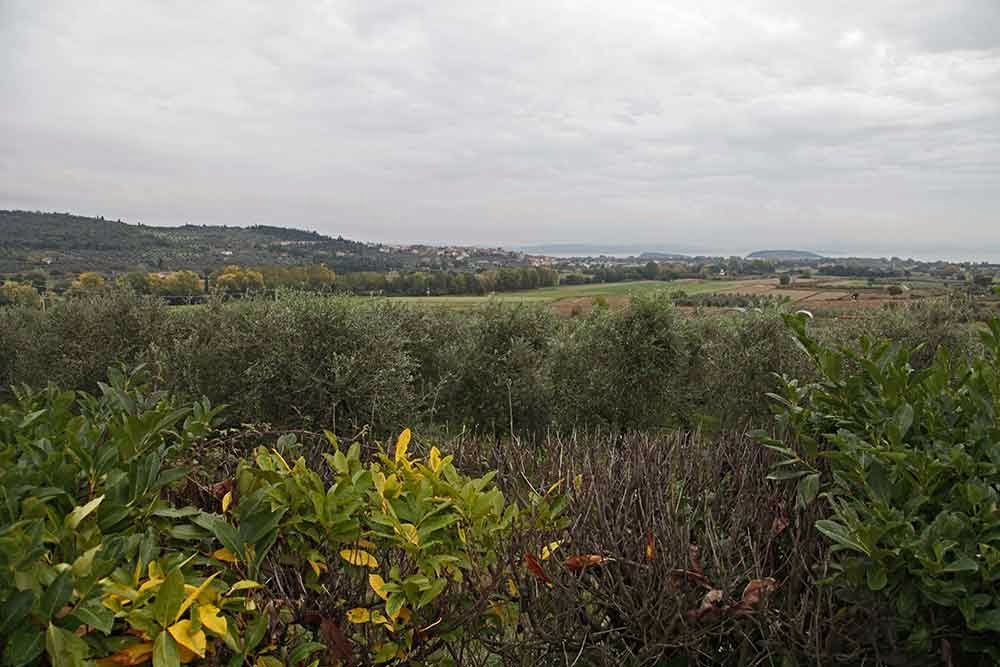
the place where consul Flaminius was killed

When travelling usually I follow not so much this or that travel guide, but I follow my mind and sometimes my photo camera, which is actually the same. So when I was in Tuscany in Italy a few weeks ago, I found it more interesting to be led by the Montaigne’s footsteps and to walk on the battle field of Lake Trasimene where Hannibal ambushed a Roman army than to see the great objects of art admired by many, although one can doubt whether most of them really admire them or that they admire them “because they have to” (as a pen friend remarked to me). But it is not up to me to judge the truth of the admiration of others. That would be quite arrogant and these “others” could probably say the same about me, and with right. Anyway, I remember that when I was in Florence a few years ago I walked into a church and my eye was caught by a statue on the wall and, although not being an art connoisseur, I immediately saw how excellent it was and when I looked up in my travel guide who had made it, I saw that it was by Donatello. Since Donatello is recognized as a famous and very good sculptor, I concluded that there must be something objective in what is good art and what is bad art and that even a layman can see that and can sincerely enjoy it. Nevertheless, my feeling tells me that my mind must lead me to other places when I am on a travel. Or most of the time.
Anyway, walking on the battle field of Lake Trasimene I wondered why Montaigne hadn’t been here, since he needed to make only a brief detour in order to go there. Montaigne writes several times about Hannibal in his essays, although not over consul Flaminius who was commanding the Roman army there, if I am right. I think that a walk, or rather a horse ride a Montaigne’s case, would have given him new insights and would have stimulated him to new themes, if he had looked at the details of the battle and had compared the reports of Livy and other authors with what he had seen in person on the terrain. And certainly he would have got inspiration if he would have studied what had happened after the battle, if he didn’t know it already. For after the Romans had heard about what was a calamity for them (15.000 soldiers had been killed, 6.000 had been taken captive and only 4.000 soldiers escaped), they were seized by panic and, as they had done so often in such situations in the past, they appointed a dictator who was charged to solve the situation and, of course, to beat Hannibal. However, Quintus Fabius Maximus, the new man on the top of the Roman Republic, chose the strategy of avoiding a direct confrontation with Hannibal. Instead he used a tactics of law-level harassment in order to exhaust his opponent and to give Rome time to rebuild its military strength. By doing so Fabius got the nickname Cunctator or “Delayer”. But the Romans were not very charmed by this approach. They dismissed Fabius and elected two consuls instead, who gave battle to Hannibal in the Battle of Cannae, which was even a worse defeat for the Romans than the Battle of Lake Trasimene. Apparently, Fabius’s strategy of avoiding and exhausting was not so bad. Even more, the same method was used by the Russian generals Barclay de Tolly and Kutuzov in 1812 when Napoleon invaded Russia and occupied Moscow. In this case the strategy was a big success and Napoleon was forced to leave Russia, which actually meant the end of his reign. Of course, Montaigne couldn’t have known about Napoleon, but without a doubt a few other such instances would have come to his mind. If he would have written about them, I think he would have given his essay the title “Whether one must always directly confront an enemy” and the upshot would have been that procrastination is not always as bad as it looks on the face of it.

Monday, November 04, 2013

In Montaigne’s footsteps

The house where Montaigne stayed in Bagni di Lucca

When I was in Tuscany some years ago, I suddenly realized that Montaigne had been there, too, on his trip to Germany and from there to Italy. But where exactly had he been? I seemed to remember only vaguely that he must have stayed some time in Bagni di Lucca, but I wasn’t sure of it. I had a book on Montaigne with me, but it didn’t talk about Montaigne’s tour. It was purely philosophical. I had no Internet connection at my disposal (smartphones did not yet exist, for instance), so how to find out where Montaigne had been in Tuscany? In the end, I skipped the idea to visit the places where he had stayed, although I was a bit disappointed, also because I was so stupid not to think of it, when I prepared my trip.
But now, I had a second chance. My wife and I had planned to visit the region again and this time I was well prepared. I had reread the relevant passages of Montaigne’s travel journal and I had previewed the places where he stayed on the Internet.
Our hotel was just north of Lucca and after our arrival our first trip was to Bagni di Lucca. We followed the same road Montaigne had taken in 1581 on the right bank of the River Serchio, stream up. The typical high bridge just north of Borgo a Mozzano described by Montaigne was still there. Today only pedestrians are allowed to use it. Had it really been possible to ride over the bridge with a cart 400 years ago? For the bridge was very steep and rather narrow. But Montaigne and his company had only horses with them.
We crossed the Serchio via a modern bridge and soon we were in Bagni. First we walked a bit through the little town. Then we went to the tourist office. They had a book with names of all famous and less famous people who had stayed in Bagni. Montaigne was certainly not the only person who had got the idea to cure there, in his case because he suffered from kidney stones. The healing power of the springs was already known in Roman times and Montaigne tells us that many people from the surrounding area used to spend the summer there. Especially in the 19th century it was a popular health resort, but today the bloom days of the spa seem to have gone.
Montaigne had rented rooms in a house in La Villa, a residential quarter a bit separate from the actual town, mainly existing of mansions and villas. The road leading to it is rather steep but from here you have a view on the roofs of the houses of Bagni. Where the road enters La Villa, there is a little square. To the left I see the stately mansion where Montaigne had passed many weeks in the late spring and early summer of 1581 and then again in August and September. The house is not open to the public but a plaquette tells us that Montaigne has stayed here 74 days all together. In front of the building, where once coaches were parked, now modern cars take their places. The mansion has been built against a slope. A staircase on the right side brings us to a garden on the level of the top floor of the house. Actually it’s not more than a lawn. A mountain wall closes the garden on the backside. A basin with a tap has been built in it. Was it already there in the days of Montaigne and has he used the tap then? As such it’s a bit a strange idea for me to imagine that the man must have gone there where I am now stepping in his footprints so to speak.
We walked a bit around the house and I absorbed the scene as well as I could. Then we went down again to the centre of Bagni. Later on our trip we met Montaigne yet a few times more. In Siena, for instance. According to Montaigne, its square is the most beautiful to be found anywhere. The square is beautiful, indeed, but it is clear that Montaigne hasn’t been in Brussels (or was the “Grand Place” not so beautiful in his days, as it is today? Anyway, Montaigne hasn’t been there). In the spa of Bagno Vignoni we saw the large basin with hot water, which has also been described by Montaigne. What surprises me is that he hasn’t visited the battle field near Lake Trasimene, where Hannibal defeated the Roman army in one of the most famous ambushes in military history. Montaigne needed only to make a little detour in order to go there. It’s true; there are no medicinal springs nearby. But isn’t it so that his interest was usually much wider than that, also when travelling? We can learn a lot of his openness for new experiences and his receptivity to new customs and habits, also on his travels abroad.