Share on Facebook

Monday, August 29, 2022

Informational cascades

Skógafoss, Iceland

Sometimes we make our own decisions; sometimes we follow a decision taken by someone else. There can be good reasons for following another person, but if
an agent makes a decision based on what another person does without regard to his own private information, just because s/he thinks that what the other decides must be right, and if other agents do so as well, then we are in an informational cascade (or information cascade).
Let’s take an example (from Noise by Daniel Kahneman et al. pp. 100-103). Ten people must decide whom to hire for an important position. There are three candidates and the members of the group announce their views in sequence. Arthur speaks first and sees Thomas as the best choice. Then Barbara speaks. She is not sure that Thomas is the best choice but is unsure who is. She trusts Arthur and so she chooses Thomas as well. Next it’s Charles’s turn. He thinks that Thomas is not a good candidate but that Julie is. Nevertheless, he also chooses Thomas, not because he feels under pressure and doesn’t have the courage to give a different opinion, but because he thinks that Arthur and Barbara have good reasons for their choices. Unless David, person 4, has strong reasons against the choice of Thomas, probably he’ll follow the others before him. If so, then we are in a cascade. Etc.
Informational cascades are also a much happening economic phenomenon. Here is an example, taken from the Investopedia: Someone might think that a certain financial pundit has more knowledge and information than he himself has. Therefore, he imitates the pundit’s stock picks. A neighbour observes him boasting about his stock picks, and she also picks the same stocks. Another neighbour notices that both people chose the same stocks and assumes that those stocks must be good picks, simply because more than one person has picked them. An informational cascade has begun, and all of the participants have very little information to back up their decision-making.
Informational cascades also happen in daily life. A group of friends wants to go out to eat together. Each one of the friends has his or her preferences where to go. One proposes a restaurant and the others agree.
There are several conditions that make that we can speak of an informational cascade (see here and here):
- There is a decision to be made; agents make the decision sequentially, and each agent can observe the choices made by those who acted earlier.
- A limited action space exists (e.g. an adopt/reject decision).
- Agents make decisions rationally based on the – usually limited – information they have.
- Agents do not have access to the private information of others.
Note that each decision is based on the information the agent has and that the agent is not deciding under group pressure. Maybe s/he has some doubts about the group decision, but in fact s/he trusts that the others are right and actually the agent lacks good reasons that they are not. Otherwise s/he would have said so. From this point of view, it’s not necessarily irrational for the later deciding agents to follow the decision others have already expressed. If you are not really sure what to do, it may be smart to follow the others.
Nevertheless, an informational cascade is not unproblematic. First, if another agent would have expressed his or her choice first, another decision might have been taken by the group; or, second, if the first agent also was not really sure what to decide, s/he might have taken another decision. So the final decision can be the result of the arbitrary decision of the person speaking first. Third, people tend to ignore that other agents are in the same informational cascade and are not deciding independently. They may think that there is some crowd wisdom, while in fact they follow the initial view of the first decider. Fourth, the decision of the first decider may be completely wrong with possible nasty consequences if everybody follows this person.
Although the decision procedure just sketched is far from uncommon, it is risky. Note that it is a procedure that is applied in a situation in which the agents are not really sure what to do and that their decisions are sequentially taken and known to everybody. In such a situation the final decision tends to be arbitrary and can even have fatal consequences. Market leaders can be the source of much financial if not economic harm, if others mistakenly think that they have the right information and therefore follow them. It is also possible that a decider is not reliable, and a non-reliable agent who wants to manipulate a decision to his or her advantage can try to be the one who decides first, hoping that others will follow. Or, a committee can take the wrong decision, such as hiring the wrong person, if it uses a sequential decision procedure and gets into a cascade. Or friends can go to the wrong restaurant. One solution to avoid an informational cascade is to vote by secret ballot, but this doesn’t work in a financial market. Then we come to such solutions as think twice before you act. However, informational cascades can also have positive effects. The fall of the German Democratic Republic in 1989 was the result of initially small protests in Leipzig that gradually grew because more and more people decided to join, just because others did. People followed other people without really knowing whether to do so was right, in the sense that the protests could have led to a massacre as well. Informational cascades are fragile phenomena.

Sources: The references quoted in the text.

Thursday, August 25, 2022

Random quote
The average expert is roughly as accurate as a dart-throwing chimpanzee

Philip E. Tetlock (1954-)

Monday, August 22, 2022

Why I become tired, when I write a blog


I often make a bike ride. When I ride with an easy speed and the distance is not long, afterwards I feel relaxed. When I ride a long distance with a fast speed, I feel tired at the end. We think it’s normal that making a great physical effort makes you tired. It is because your muscles become filled with lactic acid, which must be cleared up in order to feel fresh and rested again.
Once a week I write a blog. When I have finished it, I feel tired, for usually it is a hard job. So, afterwards I want to relax, for instance by making an easy bike ride. But why do I feel tired? Most of the time I sat down in my chair and only my fingers moved a little bit in order to type my blog and to do a few internet searches. Nonetheless, I feel tired. Even more, mentally tired people who must take decisions, like chess players, are going to make mistakes, just because they are tired; types of mistakes they wouldn’t make with a fresh mind. How come?
Several explanations have been given why thinking makes you tired. Actually, you are not tired but bored, some say. You want to do something else and so your brain tells you that you are tired. Or, another explanation, the deeper you go into a problem, the more complicated it seems, so that’s why you are going to make mistakes. It’s a way to explain mistakes made by chess players. At the beginning of a game they can use their routine, but later on they must rely on their insight and then they can fail. Other explanations for mental fatigue have been suggested as well. However, a group of French researchers didn’t find the existing explanations very satisfying, so they developed their own approach. Let’s look in the brain and see what happens if people get mentally tired, they thought, and they developed relevant tests. If you make a light physical or mental effort, you don’t become tired, but you do if your effort is hard. Maybe, you become mentally tired because some stuff piles up in your brain when you are thinking, which makes that you feel fatigue; just as in the case of a physical effort like cycling. Therefore, these researchers developed a light and a difficult version of the same mental task and watched the brains of their test persons and looked what happened; moreover, they looked at the reaction of the pupils. The task chosen lasted several hours. For watching into the brains of the test persons, they used an MRS scanner (MRS =
magnetic resonance spectroscopy). With such a scanner you can see what happens with the blood currents and the chemistry in the brain, when the test person is active or passive.
What did they find? Indeed, becoming tired when doing a mental task is not a mental affaire, but it is as physical as becoming tired in your legs when cycling. There were clear differences between the test persons that did a light task (and didn’t become tired) and those who did a hard task (which made them tired). The researchers
saw signs of fatigue, including reduced pupil dilation, only in the latter group. Those in that group also showed in their choices a shift toward options proposing rewards at short delay with little effort. But most important, they had higher levels of glutamate in synapses of the brain’s prefrontal cortex. The prefrontal cortex is the part of the brain in the forehead where decisions are taken. These results made the researchers conclude, together with earlier evidence, that it is likely that glutamate accumulation makes further activation of the prefrontal cortex more costly, such that cognitive control is more difficult after a mentally tough workday. In other words, glutamate poisons your brain and that’s why it disturbs your thinking. Only after it has been cleared up, you feel fresh and rested again. Actually, there is not much difference between feeling physical and mental fatigue. The difference is in the details and the solution is also the same, and actually not really surprising: take a rest or take a nap. And if you are really tired, go to bed. The conclusion feels like kicking open an open door. Nevertheless, it isn’t. People often think: I am tired, the task must be done. And they go on till the job has finished. Maybe, they even think that feeling mentally tired is an illusion, and anyway that it’s not that bad (think of doctors, at the end of a workday). Maybe, there are other reasons to go on, but from a psychological point of view it’s a bad idea: It’s almost sure that mistakes will be made. Fatigue is an objective real phenomenon with a physical base. So, avoid making important decisions when you are tired.
The knowledge from this study (and from future research) can also help to tackle mental problems. For example, the researchers say, monitoring of prefrontal metabolites could help to detect severe mental fatigue. Such an ability may help adjust work agendas to avoid burnout. In future studies, the researchers hope to learn why the prefrontal cortex seems especially susceptible to glutamate accumulation and fatigue. They’re also curious to learn whether the same markers of fatigue in the brain may predict recovery from health conditions, such as depression or cancer.
So, now you understand why I am tired, when I have written a blog.

Sources
- “Why thinking hard makes you tired”, Cell Press (here and there above literally quoted or paraphrased)
- Antonius Wiehler et al. “A neuro-metabolic account of why daylong cognitive work alters the control of economic decisions

Thursday, August 18, 2022

Random quote
The ego is the product of the development of the personality and not - as many psychologists assume - the producer of the personality.

Gerhard Roth (1942-)

Monday, August 15, 2022

Killed in action, 18 years young


I assume that you have guessed from my mini-blog about Wilfred Owen that I have been in France recently and that I have visited his grave. I published this short mini-blog because I had no time to write a real blog but didn’t want you to be too long without one.
In fact, I didn’t go to France for visiting Owen’s grave, for when I left home, I hadn’t realized that it was not far from where I had planned to stay. However, my trip had to do with the cause Owen had died for, for I went to the battlefields east of Reims, in the north of France. The region around Reims is called Champagne. It is known by most people for its wine, but those interested in the First World War know that there has been heavy fighting in the region, especially in 1915. These fights are known as the First and Second Battles of Champagne. I have a website with photos of World War One monuments and just photos related to these battles yet failed there; so a good reason to go there this summer.
As everywhere along the former front line in Northern France and Belgium, also the region east of Reims is full of war monuments and traces of World War One. Most important is the War Memorial for the Armies of Champagne near Sainte-Marie-à-Py, but, as everywhere along the former Western Front, most striking is the big number of war cemeteries. Only in these two battles more than 100,000 French soldiers plus the same number of German soldiers died. Some cemeteries are only for French soldiers, other ones are for German soldiers and again other ones are mixed in the sense that they have sections for both nationalities. Some soldiers got individual graves and other soldiers have been buried in mass graves, especially those killed in the beginning of the war. Most soldiers are known by name but some have a stone or cross with the inscription that an unknown soldier lies there. When I am in the former war zone, I always visit several war cemeteries. I walk along the crosses and stones, read some of the names, when they died and how old they were. Most were in their twenties. Sometimes I read also the book with names which is always there and sometimes I also sign the guestbook.
In the meantime, I had discovered that Wilfred Owen had been buried not far from where we stayed, but more to the north, in Ors in the Nord Department. So after having been a week in Champagne my wife and I decided to spend there the last days of our trip and to visit Owen’s grave.
Wilfred Owen has been buried in the British section of the Ors Communal Cemetery. He was killed while he was encouraging his men when they tried to cross the Oise-Sambre Canal. Owen had previously been treated for “shell shock” in a psychiatric hospital and needn’t to go back to war, but he chose to do so since he felt guilty because his comrades were fighting and run the risk to be killed, while he was safe in England. Owen was killed on the 4th November 1918, one week before the war ended.
It was easy to find his grave in the Ors Communal Cemetery, since there had been put a few little crosses in front of the stone by admirers. It was in the last row of the British section, third from the left. Owen was 25 years old when killed, so he was quite young. On a gravestone more to the right, I read the name of a captain who died 42 years old. Then I read the gravestone just left of Owen’s final rest-place: 63554 Private W.E. Duckworth, Lancashire Fusiliers, 4th November 1918 Age 18. I got a shock. Of course I know, that such young people had been sent to this war and had been killed there, but nevertheless I was shocked. Owen was with his 25 years already very young when he was killed, but 18 years? This private was actually yet a child, when he died. 18 years old was so young! Who was this man; who was this child? A quick internet search taught me that this private was William Edward Duckworth, son
of William and Sarah Duckworth, of 99, Warwick Rd., Carlisle. I didn’t find his date of birth, but since William Edward was yet so young, I assume that he lived yet with his parents when he left for war and so that he was also from Carlisle. But then the question remains: Why did he go to war? Of course, I know that it happened much then that such young boys went to war and that many went by their own choice. But even then, who has sent such young boys, children yet, to the battlefields?
But not only then, still today children are sent to war. The problem of child soldiers is a widespread evil. But also if a soldier is “already” 18 years old and officially no child any longer, in many respects he still is. Mentally, 18-years-olds still aren’t fully grown-up. And do they know enough about the world to bear the responsibility of a soldier in action and are they mature enough to be exposed to war risks? And what will be the consequences for a society that sees its young people lost and so will see a literally lost generation?
But times have not changed and times are not changing. Yet-nearly-children are still sent to war, like in Ukraine – by both sides – and elsewhere in the world. Still children and nearly-children are killed in action, physically or mentally.

Thursday, August 11, 2022

Random quote
War broke: and now the Winter of the world
With perishing great darkness closes in.

Wilfred Owen (1893-1918) 

Friday, August 05, 2022

Wilfred Owen


Recently I was in Ors in Northern France, where the famous British war Poet Wilfred Owen (1893-1918) was killed in action, on 4 November 1918, one week before the end of the First World War. I visited his grave there on the Communal Cemetery, where on request of his mother these words had been written on the stone:

“Shall Life renew these bodies? Of a truth
All death will he annul”

At first sight, these words, which are from a poem by Owen, make you think that he believed in a life after death, but the poem itself suggests just the opposite, since the full second sentence is:
“All death will he annul, all tears assuage?” Just the question mark shows that Owen probably did not believe in an after-life. Why then did his mother select these words?

Here is the complete poem, which is still worth to read in view of the Russian Ukraine War and all other wars that are still waging in this world:

The End
After the blast of lightning from the east,
The flourish of loud clouds, the Chariot throne,
After the drums of time have rolled and ceased
And from the bronze west long retreat is blown,

Shall Life renew these bodies? Of a truth
All death will he annul, all tears assuage?
Or fill these void veins full again with youth
And wash with an immortal water age?

When I do ask white Age, he saith not so,—
“My head hangs weighted with snow.”
And when I hearken to the Earth she saith
“My fiery heart sinks aching. It is death.
Mine ancient scars shall not be glorified
Nor my titanic tears the seas be dried.”


Sunday, July 24, 2022

Prejudices and rational thinking


I took these two examples from Steven Pinker’s book Rationality (p. 294):

1) If college admissions are fair, then affirmative action laws are no longer necessary.
College admissions are not fair.
Therefore, affirmative action laws are necessary.
[affirmative action laws: laws
to improve employment or educational opportunities for members of minority groups and for women]

2) If less severe punishments deter people from committing crime, then capital punishment should not be used.
Less severe punishments do not deter people from committing crime.
Therefore, capital punishment should be used.

What do you think: Are these arguments sound? Well, if you are progressive (in European terms) or liberal (in American terms), probably you’ll think that the first reasoning is sound (correct) and that the second one is unsound (false). On the other hand, if you are conservative (and in Europe rather ultra-right), probably you’ll think that the first reasoning is not correct while the second reasoning is okay. (see Pinker, p. 294) Apparently, the truth of the reasonings above depends on your political stand. Right?

In order to investigate this question, take this example:

3) If it rains, the streets become wet.
It doesn’t rain.
Therefore the streets don’t become wet.

What do you think of example 3? Hmm, you’ll think, whether you are progressive, liberal, conservative or ultra-right, that 3) need not be true, for it is quite well possible that a car sweeping and cleaning the streets passes, and that this car uses water to clean the streets, which makes the streets wet. Therefore, the streets can be wet, although it hasn’t rained. So argument 3 is unsound, isn’t it?

Let me now reformulate example 3 in order to bring it in line with examples 1 and 2. Let me replace “wet” by “not dry” and “not wet” by “dry”:

4) If it rains, the streets don’t stay dry.
It doesn’t rain.
Therefore the streets stay dry.

For the same reason why argument 3 was unsound, also argument 4 is unsound, so false: It is quite well possible that a car sweeping and cleaning the streets passes and that this car uses water to clean the streets, so that the streets don’t stay dry.
We can argument 4 also write this way, by replacing “it rains” by “P” and “the street stays dry” by “Q”. Then we get:

5) If P then not Q
Not P
Therefore Q

As we just have seen, this argument is unsound (false).

Let us now return to examples 1 and 2. A close look at them makes clear that both 1) and 2) have the form of the unsound argument 5. For instance, in example 1 “college admissions are fair” is “P” and “affirmative action laws are necessary” is “Q”. I leave it to you to fill in P and Q for example 2. Therefore, since reasoning 5 is unsound, also examples 1 and 2 contain unsound reasonings, despite your political stand. However, we often see that, as soon as a reasoning becomes a little bit complicated or a little bit obscure and difficult to follow without thinking a little bit deeper, people stop thinking. Or people do not simply think “That cannot be right, or maybe it nevertheless is? Let’s find out what the problem is.” No, they think “This should not be right, and therefore it isn’t.” (or “This should be right, and therefore it is.”) Then they stop thinking further and adapt the facts to what they think that the facts are. In other words, they found their reasoning and view of the facts on prejudices. They walk into the trap of the “myside bias” (Pinker’s term), often with open eyes. I am the first to admit that I, too, regularly make this type of mistake, for reasonings are often not really clear and easy to get a grip on. Often prejudices commandeer the mind. So, people tend to think what they think that they must think for all kinds of reasons, for example because they really, “autonomously” think so; under group pressure; or because they have learned to do so; or from habit; etc. All kinds of people suffer from the myside bias, despite race, gender, cognitive style, education level, whether you are a logician or not, etc. You can see the phenomenon everywhere, like in the pandemic discussions, the view of the Russia-Ukraine War, the value of simple political measures, and what more. Open your mind to what you don’t believe.

Thursday, July 21, 2022

Random quote
Reality is that which, when you stop believing in it, doesn’t go away.

Philip K. Dick (1928-1982)

Monday, July 18, 2022

Unintended and unanticipated consequences of action


In my blog on the unintended consequences of actions last week, sometimes I spoke of the unintended consequences of actions and, following Robert K. Merton, sometimes of their unanticipated consequences. By using these terms interchangeably, actually I mixed up two types of effects. For what is unintended need not be unanticipated. What is unintended can both be anticipated (polluting the environment when driving your car), as unanticipated (some shortcuts are closed for cars during certain hours of the day, if too many drivers use them during rush hours). On the other hand, what is unanticipated can be unintended (that the shortcut is closed during rush hours) but it doesn’t need to be so (if you take your bike for saving the environment, your physical condition becomes better, and that’s just why you recently joined a fitness club). The latter example makes clear that unintended and/or unanticipated action consequences need not be undesirable. The terms say only something about how we perceive them, not about how we value them, and unintended and unanticipated consequences of actions can be negative as well as positive.

This little analysis helps to plan and evaluate actions in view of their side-effects. Let me discuss again the points just mentioned for getting a better oversight. I’ll add some short characterizations of the different possibilities.
I) If successful, an action has intended and anticipated consequences. We call them the purpose of the action. No surprise, of course, for that was what we were acting for.
II) However, an action can have a range of side-effects, as we just have seen:
a) unintended unanticipated consequences
- positive: good luck or unexpected benefit
- negative: bad luck or unexpected drawback
b) unintended anticipated consequences
- positive: bonus
- negative: resignation
c) intended unanticipated consequences
- positive: good fortune
- negative: doesn’t happen, for who is striving for ill fortune?
(if you prefer a schematic overview of the consequence of actions, although different in some respects, go here)

All this is yet relatively simple, although complicated enough, in case you are going to analyse real actions before they happen, since most practical situations are rather complex and cannot be surveyed in detail, for instance because the details are unknown. That’s just why actions always have unintended and/or unanticipated consequences that are not part of the agent’s purpose (the “law of unintended consequences” – see my blog last week). Matters become even more complicated if we must allow for possible recursive effects of the unintended and/or unanticipated consequences of what we intend to achieve with our action. Here, I want to mention only one, but very important recursive effect, that can even frustrate your action purpose: the perverse action consequence. It is an often-happening unintended unanticipated action effect. We call a negative action consequence perverse if it has not only negative consequences for others and for the (social) environment, but if it makes more difficult if not prevents your action purpose being reached or even makes the matter worse than before the action involved was performed. The boycott of Russian oil and gas mentioned in my last blog is a case in point. I quote (with one correction in view of the present blog): “As a way to stop the Russian attack on Ukraine the western countries have imposed a boycott of gas and oil against Russia. The idea is that it will deprive Russia of an important source of income. However, a perverse consequence of the boycott is that world market gas and oil prices have become so high that, despite the boycott, Russia earns more on energy than before the boycott was imposed.” At least the short-term consequence of the gas and oil boycott is perverse. Whether it will be so in the long run, cannot yet be foreseen because of possible unintended and unanticipated consequences.

Thursday, July 14, 2022

Random quote
Modern universities … have been at the forefront of finding ways to suppress opinions, including disinviting and drowning out speakers, removing controversial teachers from the classroom, revoking offers of jobs and support, expunging contentious articles from archives, and classifying differences of opinion as punishable harassment and discrimination.

Steven Pinker (1954-)

Monday, July 11, 2022

Unintended consequences of action


Most of my readers will have heard of the pork cycle, also called hog cycle or cattle cycle. In short, it’s this: You are a pig farmer and the prices of pigs are high, so you decide to breed more pigs. However, you are not the only farmer that gets the idea and most pig farmers in your region decide to breed more pigs. As a result, by the time that the pigs must be sold the supply of pigs is that high that the price has become low. But that’s not what the farmers intended when they decided to breed more pigs and it’s not what they had foreseen.
The case just described is an instance of a so-called unintended consequence of action, in this case in the version of Adam Smith: an “invisible hand” guides the pig market in a way that is not foreseen and not intended by the individual pig farmers who invested in their farms hoping to get high prices for their product.
Here is an individual example: You use your car to go to work. However, your car pollutes the environment. It’s not what you want, but you know no other means to go to your work place. It’s too far to go by bike, and no bus or train goes there. So, polluting the environment is an unintended consequence of your drive to work.
The idea of unintended consequences of what we do has first been discussed by John Locke, more than 400 years ago, but it has become a much-discussed theme in sociology and philosophy since, in 1936, the American sociologist Robert K. Merton published his article “The unanticipated consequences of purposeful social action”. He discussed several types of, what he called, “unanticipated consequences” of action. Moreover, he analysed five causes why they may happen:
- ignorance
- errors in analysis of the problem
- short-term interests which are seen as more important than long-term interests
- basic values which may make that one avoids tackling long-term consequences of the action
- self-defeating prophecy: people try to stop expected negative consequences of an action before they happen. Or, to say it in another way, the expected and planned consequence of an action doesn’t happen because people hit by the action react in an unexpected way.
Especially the first three factors are important. Once you are aware of the idea that unintended consequences of what you do may happen, it is to be expected that most of them can be avoided (if you don’t want them) by a thorough analysis before you act. Nevertheless many situations are so complicated that it is hardly possible to analyse the consequences of acting in detail. Anyway, unintended consequences of action are that common that there seems to be a “law of unintended consequences”: Any action has results that are not part of the agent’s purpose.
Are you responsible for the unintended consequence of your actions? I think that it depends on the action and its consequences. Some unintended consequences are that important compared with the action itself that they must be taken into account before you act. Many people have been sentenced in court because they didn’t! In this context, the next case is important, which I have discussed before: A establishes a company, which has detrimental side effects for the environment. Another person, B, establishes also a company, but this company has positive side effects for the environment. Both A and B are only interested in the profitability of their companies, though they know about the side effects. Then usually people say that A hurts the environment intentionally, while they do not say that B helps the environment intentionally. Apparently, people think that you are responsible for the negative unintended consequences of what you do, while you aren’t for the positive consequences. It’s a thing you should take into account when you assess the consequences of an action.
That the problem of unintended action consequences is not to be ignored and is important to consider can be seen from the present rising oil and gas prices on the world energy market. As a way to stop the Russian attack on Ukraine the western countries have imposed a boycott of gas and oil against Russia. The idea is that it will deprive Russia of an important source of income. However, an unintended consequence of the boycott is that world market gas and oil prices have become so high that, despite the boycott, Russia earns more on energy than before the boycott was imposed. A thorough analysis of the problem might have prevented this unanticipated and unwanted effect resulting in a better thought-out plan of action.

Reference
Robert K. Merton, “The unanticipated consequences of purposeful social action” in American Sociological Review, Vol. 1, No. 6 (Dec. 1936), pp. 894-904.

Thursday, July 07, 2022

Random quote
Among our fiercest problems today is convincing people to accept the solutions when we do find them.

Steven Pinker (1954-)

Monday, July 04, 2022

Does history repeat itself?

French war cemetery and ossuary Douaumont for soldiers killed
in the Battle of Verdun (1916) in the First World War

Sometimes I have the impression that history repeats itself; not in the sense of a feeling of déjà vu, which is not more than a feeling of recurrence, but in the sense of a real recurrence, albeit it adapted to the changed circumstances. Take for instance the present Russia-Ukraine War. First of all, it is a unique war in a unique time of history, the Nuclear Age. It’s also an almost direct clash between two superpowers, Russia and the USA, in which the latter is supported by its NATO allies. Moreover, it is a kind of border conflict between military powers in which one power – Russia – tries to regain lost territory, which was – in its view – illegally annexed by the other power, the USA and its allies. In that sense the war is not really new. Think of the Korean War (1950-1953) and the Vietnam War (1955-1975), which were the most important border conflicts between the superpowers after World War Two. Without a doubt there are resemblances between these wars and the Russia-Ukraine War, but that is not what I mean when I say that in the latter war history repeats itself. The differences between the three wars just mentioned are probably bigger than their similarities. No, what strikes me in the present Russia-Ukraine War is that it is not so much a recurrence o
f other border conflicts between great powers but of one of the most important direct clashes ever between big powers, namely the First World War (the “Great War”), which raged in Europe and in the world a century ago, between 1914 and 1918. The similarities between the Russia-Ukraine War and the First World War are the more striking, if you see the former not as a war between Russia and Ukraine but, as said, as a direct clash between the superpowers Russia and the USA and its allies. For isn’t it so that especially in the European Union (but also in Switzerland, which is not an EU member) they say that Ukraine fights “for us”; that it defends democracy against the authoritarian Russia “for us”?
Be it as it may, when saying that history repeats itself in this war, in the first place I think of the military events and less so of the political background. What then are the military similarities between the Russia-Ukraine War and the Great War? Here are the most important ones:
- In August 1914 Germany attacked France and Belgium, expecting that the resulting war would be short and that soon it could occupy Paris, just as in 1871. However, especially the Belgian resistance was stronger than expected. The German advance went slower than hoped and in the end was stopped at the First Battle of the Marne (5-12 September 1914). In the present Russia-Ukraine War also Russia thought to make a quick victory and that it could easily take Kiev, the Ukrainian capital. However, strong Ukrainian resistance and adverse conditions of the ground made that the attack was stopped.
- Frustrated by the Belgian and French resistance the often-inexperienced German troops committed war crimes by killing innocent civilians. In Ukraine we have seen the same: Frustrated by the Ukrainian resistance the often-inexperienced Russian troops committed war crimes by killing innocent civilians.
- After having lost the Battle of the Marne the German troops withdrew and took the best positions. After having been stopped in the Kiev area, the Russian troops withdrew from there and concentrated there where they now see the best chances to win.
- Since direct attacks had failed, the war switched to a kind of trench war: both sides dig in in trenches which function as lines of defence against attacks from the other side. We have seen this in World War One and we see it now in the Russia-Ukraine War.
- Since direct infantry attacks on trenches have no sense or are difficult, because the defenders are in the best position, artillery gets a significant role in breaking the resistance of the enemy and preparing infantry attacks.
So far the analogies between the present Russia-Ukraine War and the First World War. We don’t know how the present war will develop. But the First World War lasted long and became a war of attrition ending with a victory for France and its allies after many setbacks during the first war years. It will be in the future, whether the Russia-Ukraine War will develop in the same way. Anyway, some lessons can be learned from the parallels between both wars. Just as in 1914, also now in 2022 the attacking party overestimated its own strength and underestimated the strength (and the will power!) of the defending party. It is a general human mistake: Most people think that they are better, stronger, more powerful etc. than they really are. People overestimate themselves and think that they are better than average. It’s a common mistake in thought. People forget that as many people are better than average as there are worse. Even if they realize this logical truth, even then they think that they at least will succeed. But you can better be a pessimist of your own capacities, for whom we call a pessimist usually is a realist. And that is what we see again and again: Overoptimism is a recurrent fact in history. Another recurrent fact in history is that most of us ignore this fact. Then history repeats itself in the same old pitfalls.

Monday, June 27, 2022

Random quote
Responsibility in general is going to look a lot more like responsibility for omission. What we are going to blame you for is not that other force that was working in you or on you, but for the fact that you let it do that, that you failed to pick up the reins and take control of your own movements.

Christine Korsgaard (1952-) 

Monday, June 20, 2022

The right age

In the last essay of Book I of his Essays titled “Of Age” Montaigne talks about age and ageing. In this essay he discusses two themes: The right age to die and the right age to do something. As for the first, he tells us about Cato the Younger, who “said … to those who would stay his hand from killing himself, am I now of an age to be reproached that I go out of the world too soon?” And then Montaigne adds: “And yet he was but eight-and-forty years old.” This remark is a bit strange, for when in 1571 Montaigne retired from public life to this castle, he wrote on the wall of his study that he would spend there “what little remains of his life”. However, Montaigne was then only 38 years old, but he did as if he was already an old man. This illustrates that age is a relative idea and that you are as old as you feel. Some are apparently already old at the age of 48, while others are still “young” at the age of 100. I told you once about Robert Marchand, who stayed cycling almost till his death at the age of 109. 105 years old, he still felt fit enough to set up a world record in one-hour track cycling (see here), so at an age that most of us will not reach. Nonetheless, if a person dies “already” at the age of, say, 96 or 87, nobody will call this a premature death, though one would say so nowadays when a person dies at the age of 48, like Cato, or 59, like Montaigne. This raises the question what a “normal” age to die is. I think that such an answer cannot be given. It depends on the time in which you live, the country and the average age of dying in your country and on some other factors.
If there isn’t a normal age to die, is there then something like a “normal” death? I think that most of us will consider a normal death dying in your own bed in your own house, weakened by a high age, weary of life. Is it really normal? No, so Montaigne: Isn’t it “a kind of death of all others the most rare and very seldom seen? We call that only a natural death; as if it were contrary to nature to see a man break his neck with a fall, be drowned in shipwreck, be snatched away with a pleurisy or the plague, and as if our ordinary condition did not expose us to these inconveniences. … [However]; we ought rather, peradventure, to call that natural which is general, common, and universal. To die of old age is a death rare, extraordinary, and singular, and, therefore, so much less natural than the others.” What should I add?
The other theme in “Of Age” is the right age to do something. For instance, what is the legal marriage age? In the Netherlands you must be 18 years old at least. Once your parents had to consent when you were not yet 30 years old; later this age was 21, and now you don’t need your parents’ consent any longer. However, the marriageable age varies according to country, culture and time. Even child marriages happen or happened. Other examples of age limits are the compulsory school age, the age to get a driver’s license, the age that employers must pay an adult wage, or, on the opposite side of life, the retirement age.
Many age limits separate young and adult, and they illustrate that adulthood is a relative affair. Montaigne himself thinks that “our souls are adult at twenty as much as they are ever like to be, and as capable then as ever.” Even more, Montaigne thinks that “a soul that has not by that time given evident earnest of its force and virtue will never after come to proof. The natural qualities and virtues produce what they have of vigorous and fine, within that term or never.” And if it is not when you are 20 years old, “of all the great human actions I ever heard or read of, of what sort soever, I have observed, both in former ages and our own, more were performed before the age of thirty than after”. It’s what many people often thought and maybe still think. True, many scientists did their most important discoveries before the age of 30 (Einstein is a case in point), but generally it is not so, also not for scientists. Many qualities need time to ripen, and many people often become good just at a later age, when the right combination of creativity, knowledge, reflection, social experience and the like has developed.
Anyway, after the age of 30 the physical decay of human beings sets in. And mentally? Many older people say, for example at the age of 60: Physically I have become older. My body cannot do any longer what I could do when I was young. Mentally, however, I am still the same as when I was 20 years old. Is it true? Maybe it feels so, but it’s an illusion. Also your mind gradually decays; or at least it changes. Also in your head you don’t stay the same young girl or guy you once were. As Montaigne says, it can even happen that the mind faster submits to age than the body, but when this happens, people often don’t notice it and then “so much greater is the danger”. It’s an illusion to think that mentally you don’t change through the years. You shouldn't fool yourself.

Thursday, June 16, 2022

Random quote
It is one of the demerits of the traditional theory of causality that it has created an artificial opposition between determinism and the freedom of which we are introspectively conscious.

Bertrand Russell (1872-1970)

Monday, June 13, 2022

What do I know?


Montaigne’s Essays remain interesting, also more than 400 years after its first publication. I cannot stop taking them in my hands now and then and read one or another essay. I have underlined many passages and I have marked those essays that I find most interesting. One of them is essay 27 (or 26 in some editions like the Gutenberg translation; but this time I’ll quote from the translation by Charles Cotton). This essay is very relevant to the present situation in which the world is amid a pandemic and in which a war in Europe undermines the social and economic order. In this situation there is much confusion about what is true and what is false; what is fact and what is fake. Scientific facts are being opposed to alternative ideas about the origin of the pandemic. It is not always clear what is happening on the European battlefield or what the real reasons behind the war are. In this confusing situation, Montaigne gives us useful advices that help us finding our way.
Essay 27 (26) is titled “It is folly to refer truth and error to our own capacity”. Montaigne says here that we tend to believe what we already think to know and to reject what seems unlikely to us. However, he wonders whether this is right. At first sight it is, for we believe what we believe not without reason. However, when we take a closer look at the reasons for our beliefs, it is often so that our beliefs are only a matter of custom. When we try to find out why we believe something that someone else may consider weird “assuredly we shall find that it is rather custom than knowledge that takes away their strangeness”. We tend to think that people who hold different views are less reasonable than we are. But even if this would be true, “tis a foolish presumption to slight and condemn all things for false that do not appear to us probable; which is the ordinary vice of such as fancy themselves wiser than their neighbors.”
Of course, we must not automatically accept anything that is told to us, but on the other hand, we must not reject it in advance, just because it seems unlikely. According to Montaigne we must try to find a middle course between credulity and scepticism. It is arrogant to consider impossible everything that seems unlikely to us. “If we give the names of monster and miracle to everything our reason cannot comprehend, how many are continually presented before our eyes?” Much of what we consider unlikely seems unlikely to us because of our prejudices is what Montaigne apparently wants to tell us here.
Now it often happens that otherwise reliable people tell us unbelievable things. If we don’t want to believe them, even then let us not reject as impossible what they told us. Who knows what evidence we’ll get later for it? Better is, so Montaigne, to suspend the judgment. “[T]o condemn [something] as impossible, is by a temerarious presumption to pretend to know the utmost bounds of possibility.” For there is a “difference betwixt the impossible and the unusual, and betwixt that which is contrary to the order and course of nature and contrary to the common opinion of men”. On the one hand, one must not believe rashly and on the other hand not be too incredulous. What now seems unlikely, can later turn out to be true. “Tis a presumption of great danger and consequence, besides the absurd temerity it draws after it, to contemn what we do not comprehend.” We, too, continuously change our minds. What we once considered true, may later be proved to be false, and the other way round. Moreover, what we think is full of contradictions. “Why do we not consider what contradictions we find in our own judgments; how many things were yesterday articles of our faith, that to-day appear no other than fables? Glory and curiosity are the scourges of the soul; the last prompts us to thrust our noses into everything, the other forbids us to leave anything doubtful and undecided.”
So far Montaigne in essay 27 (26). Montaigne lived in a time when science began to develop. Eternal truths were overthrown. What once were facts was uncovered as fake. Or fake was shown to be fact. People of both sides denounced each other. That’s also what we see in the present world; a world full of confusion and contradiction. I think that I don’t need to explain this here. We hear many half-truths and half-lies; facts that later had to be changed into other facts; conspiracy theories; and who knows what more. But Montaigne tells us that we must be open to all views. He does not say that we must believe everything, but we must lend an ear to other views, and often we’ll see that it’s better to suspend a definitive judgment than just state that the truth is on our side. How often isn’t it so that a fact becomes fake (or vice versa)? Not without reason Montaigne’s motto was “Que sais je?”. What do I know?

Thursday, June 09, 2022

Random quote
There is a difference between the impossible and the unusual, and between that which is contrary to the order and course of nature and contrary to the common opinion of men.

Michel de Montaigne (1533-1592)

Monday, June 06, 2022

The Pinocchio Sensation


Most of us tell the truth most of the time. Nevertheless, sometimes we lie, for good reasons or for bad reasons. For some people lying belongs to their profession. Or they tell half-truths, which is the same as telling half-lies. I think that politicians belong to this category, and I think that politicians tell half-truths and so also half-lies more often than the average person does. Also they can have good or bad reasons for doing so. They can lie in the interest of the state, but often they lie in the interest of themselves. For politicians strive for power; otherwise they wouldn’t be politicians. It can be that they want to promote a certain idea and they think that they can best do so in politics, or they can strive for power simply because they want to have power. Often it’s a mixture of both. But then it would be interesting to know what the real motives and plans of politicians are, especially in a state where we elect our representatives. Then we would like to know whether our representatives tell the truth or try to mislead us by telling lies, so that, once in function, they can execute their own agendas. Therefore, it would be nice to have a kind of lie detector. For example, did the Russian president Putin really want to chase away the Nazis from Ukraine in the present war or is it a pretext for his strive for power or for something else? Or, to give an example from my own country, the Dutch prime minister Rutte often says “I don’t remember; I haven’t an active memory of it.” Then, we would like to know, whether he really had forgotten the case concerned, or whether he doesn’t he want to tell the truth. Since we cannot force a politician to do a test with a lie detector, it would be nice if there were a kind of innate lie detector. The Italian writer Carlo Collodi tells us the story of Pinocchio, whose nose became longer, when he lied. But alas, it’s a fairy tale, not something that really happened. In this sense it’s a lie that Collodi told us, although for most people it’s an acceptable lie, since they like fairy tales. There are no noses that grow when lies are told. So, politicians and human beings in general can go on lying and we must simply believe them, unless we can prove that they lie.
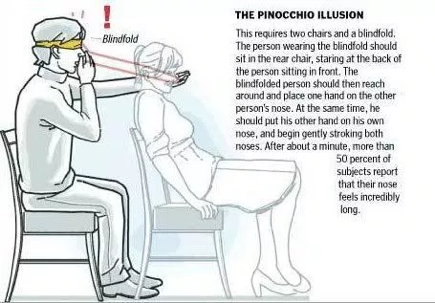
Is it really so that noses cannot enlarge in this way? Yes and no. Noses don’t grow when people lie, but there is a psychological phenomenon that gives you the illusion that your nose grows, although not because you are lying, but because your nose is stimulated in a special way. The phenomenon is called the Pinocchio Illusion or Phantom Nose Illusion. There are several ways to evoke the sensation that your nose grows. Here is one way that you can practice yourself (quoted from this website, where you can also find other ways to evoke the Pinocchio Illusion):
Ask a friend to help you. “Since you will be the one experiencing the illusion, you will sit in a chair behind your friend. You should cover your eyes by either using a blindfold, or simply closing them. Next, you will reach out with whatever hand and simply find the nose of your friend, while using your other hand to touch your nose. At the same time stroke your nose as well as your friends using the same movement. In roughly thirty seconds to one minute, you may get a weird sensation that your nose is displaced from your body, or that your nose has grown super long. It is also possible that you might experience both of these outcomes!” (here you find another description with an illustration)
Did you try it and succeeded to enlarge your nose? Then you have enlarged your nose without telling a lie. In fact, it’s a way to become Pinocchio without lying. But, alas, it’s an illusion; your nose didn’t change and stayed as short or long as it was before you applied the trick. You simply confused your brain. The trick made your brain think that your nose became longer, while in fact nothing changed. Your nose doesn’t grow when you tell lies and it doesn’t grow when you apply psychological tricks. Nevertheless, you had the sensation that it did, and if you hadn’t known that you were applying a trick, you really would have thought that your nose had become longer.
There are many interpretations of the Pinocchio Illusion, but in the context of my blogs I think that this one is important. Besides the Pinocchio Illusion there are many other illusions that can mislead you, but I chose this one because it is clear and funny. In this case you know that you are deceiving yourself, but for many illusions you are not aware that they happen, if you are not told so, like the Muller-Lyer Illusion. Then you’ll probably think that the illusion is reality, and then fake has become fact for you. Things are no longer what they seem to be. If you then say that such and such is the case, this is not true, and so you are not telling the truth and so you are lying in a sense. You “lie” then, seriously thinking that you tell the truth. This can happen to everyone, including to politicians. If you mistakenly think that something is the case, but it doesn’t guide your actions, the consequences of this false belief are presumably limited. However, politicians like it to act and actions based on false beliefs can be fatal. Therefore, beware of politicians, for also when they don’t intentionally lie, their beliefs may be illusions. 

Thursday, June 02, 2022

Random quote
There is not a great deal of difference between a financier who puts big sounding concerns on the market which come to grief in a few years, and the politician who promises an infinity of reforms to the citizens which he does not know how to bring about, and which resolve themselves simply into an accumulation of Parliamentary papers.
Georges Sorel (1847-1922)

Monday, May 30, 2022

Doing justice


Maximilien-Marie-Isidore de Robespierre

Nowadays many people are highly indignant when people are prosecuted only because they use their right of freedom of expression; because they expose abuses by the state; or because they want to live their own lives without interference by higher authorities who consider them a threat for the state just because of this. In modern society, it is the individual that comes first and not the state. I became again aware of this, when I read Reflections on Violence by Georges Sorel, written more than a century ago; especially when I read chapter III-II, where Sorel explains why Robespierre used so much violence against his opponents. It made me clear that oppression by dictatorial regimes is not simply a matter of the exercise of power by tyrannical rulers in favour of themselves, but that it is a different way of thinking what is right. Since I think that it’s good to understand this other way thinking in order to be better able to fight against it, let me share with you what Sorel wrote.
Although in a democratic country, basically the state is subordinate to the individual, in France of the Old Régime, so in France before the Revolution of 1789, it was just the other way round: the individual was subordinate to the state. This meant that any action not supporting the state might be considered subversive and criminal. “One of the fundamental ideas of the Old Régime”, so Sorel, “had been the employment of the penal procedure to ruin any power which was an obstacle to the monarchy. … [P]enal law … was a protection granted to the chief and to a few privileged persons whom he honoured with special favour … and … the courts of justice [were] considered as instruments of royal greatness. … The king constantly demanded of his courts of justice that they should work for the enlargement of his territories. … Justice, which seems to us nowadays created to secure the prosperity of production, and to permit its free and constantly widening development, seemed created in former days to secure the greatness of the monarchy: its essential aim was not justice, hut the welfare of the State.” [italics by Sorel] And so it could happen that feudal manors were confiscated for arbitrary motives, or that individual acts were not judged from the point of view, whether the individual had the right to act so but whether they undermined the state. The State, not the individual, was central in law.
The French Revolution didn’t simply change this mentality. Such a mentality doesn’t simply change by a regime change. After the fall of the Old Régime the new leaders came from the same social layer of dignitaries that had applied the law before the Revolution. (also Robespierre was a lawyer) So, although the regime had changed, much remained the same. The ideas changed but the mentality didn’t. Following Sorel again: “The Revolution piously gathered up [the old] tradition that gave an importance to imaginary crimes …; it seemed quite natural to explain the defeats of generals by criminal intentions, and to guillotine people who had not been able to realise hopes fostered by a public opinion, that had returned to the superstitions of childhood. … [N]owadays it is not easy to understand how a citizen can be seriously accused of plotting or of keeping up a correspondence with foreign powers or their agents in order to induce them to begin hostilities, or to enter into war with France, or to furnish them with the means therefor. Such a crime supposes that the State can be imperilled by the act of one person; this appears scarcely credible to us. Actions against enemies of the king [before the Revolution] were always conducted in an exceptional manner; the procedure was simplified as much as possible; flimsy proofs which would not have sufficed for ordinary crimes were accepted; the endeavour was to make a terrible and profoundly intimidating example.” All this was also found in the new legislation after 1789, for example, as quoted by Sorel: “The proof necessary to condemn the enemies of the people is any kind of document, material, moral, verbal or written, which can naturally obtain the assent of any just and reasonable mind. Juries in giving their verdict should be guided solely by what love of their country indicates to their conscience; their aim is the triumph of the republic and, the ruin of its enemies.” [italics by Sorel]
So, although the Old Royal Regime had fallen and the citizens had taken power, this didn’t involve as yet a transition to a modern democratic state. Far from that. The regime had changed, but the personnel hadn’t. In a sense it was old wine in new bottles. After a promising start, soon the mentality of the Old Régime returned, leading to much chaos and bloodshed and to Napoleon’s restoration of the former autocratic France. It was a new “Cult of the State” (Sorel). The Old Régime had been replaced by a “democratic despotism”, in which “the Government would have been in theory the representative of everybody, controlled by an enlightened public opinion; practically it was an absolute master.” (Tocqueville)
Once I had read this section of Sorel’s Reflections on Violence, it was easy to see the similarities with present dictatorships. Then I think in the first place of Russia after the fall of the Soviet Union in 1991. You can see the same phenomena (less so, but they clearly are there) in several Eastern European countries. Also in countries like the Netherlands and modern France still relics of the old state mentality have been left. Comparing the Russian regime change in 1991 with the French Revolution: After the fall of the Soviet Union, first there was a period of (economic) chaos and then Putin’s Restoration followed. Look how there organisations that receive foreign money are considered “foreign agents”. Look how the press is curbed by the state. The structure of the country has changed after the fall of the Soviet Union, but the same personnel stayed and by that the Soviet mentality. Also in many other countries the state continuously tries to subject the individual. The Old Régime mentality keeps reigning everywhere. Often the law of the individual is still subordinate to the law of the state, while it should be the other way round. 

Source
All quotations are from section III-II in Georges Sorel, Reflections on Violence.

Thursday, May 26, 2022

Random quote
One must be very simple to suppose that the people who would profit by the demagogic dictatorship would willingly abandon its advantages.
Georges Sorel (1847-1922)

Monday, May 23, 2022

How to become a dictator


Everyone should read the newest book by the French neuropsychiatrist Boris Cyrulnik. Recently, I saw an interview on the French TV in which Cyrulnik talked about his book and although I had something else to do, I couldn’t stop watching till the program had ended. The book is basically about inner freedom and voluntary servitude. This duality and the way you develop into one direction or the other makes that the book is about how you become the person you are. However, it also helps understand the rise of new dictatorships in this world, after a period in which democracy had been spreading. And just this aspect makes that the book is not only important to understand yourself but that it is also politically relevant. In view of the present war in Ukraine, which is actually a fight between a new democracy and a new dictatorship – the latter is new after a short democratic intermezzo –, it is not surprising that just this aspect of the book has drawn my attention. It’s not mere chance that you can interpret the book this way, for Cyrulnik’s personal experience as a Jewish child that survived the Second World War is continuously in the background of this book, which can also be seen as Cyrulnik’s way to understand these experiences. The book is so rich in ideas and analyses that I cannot do justice to it in this blog. Therefore – with the Russia-Ukraine War in my mind – I’ll pick one aspect of it: How to become a dictator.
When talking of dictators, I think that now most people will think of the Russian president Putin, but the tricks I am going to present exist already since it has become possible to manipulate your public and followers with the help of modern media. So, maybe Hitler and Mussolini were the first dictators who used them, but here there is no need to discuss about this historical question. Modern dictators mentioned by Cyrulnik are the ayatollahs in Iran, Putin in Russia and the Turkish president Erdoğan, although, to my mind, the latter is not yet a fully-fledged dictator, for in Turkey there is yet so much democracy left that it is still possible to stop Erdoğan. I want to add to these names the Hungarian prime minister Viktor Orbán, although also in Hungary it is still possible to stop his dictatorial manipulations by democratic means; even more so than in Turkey.
Most modern dictators or semi-dictators like those just mentioned didn’t get their power by a kind of coup d’état. Hitler, Putin, Erdoğan and Orbán were all elected by normal democratic procedures. Only once in power they made the steps to a dictatorship by misusing their power or by manipulation. It’s also not so that statements by future or settled dictators are not true, like statements that, for example, they have “saved” the country. The point is that dictators use such true or false statement to pretend to have reasons to break the law, to suppress the freedom of the press, to manipulate the people, to form an inner circle of supporters in order to undermine the democratic rules and institutions, to establish their personal power, and to eliminate their political opponents (event by arresting or killing them), despite the presence of laws that protect democracy and especially legally protect their opponents.
What then must a politician do to try to become a dictator? Here is Cyrulnik’s recipe:
- Say “I will be your hero”.
- Say “I am prepared to die for you”.
- Use simple words and use often the word “people”.
- Make popular allusions and insinuations, but not too many. Just for rhetoric reasons and for showing that you don’t belong to the “arrogant elite”.
- Say that there is a domestic enemy (the traitor) or a foreign enemy (like immigrants or a foreign power), and when doing so sustain your words with much drama like an opera singer dying on the stage killed by another singer.
- Finish your speech with words like: “If you want that I liberate you, obey me, follow me, vote for me.”
Present yourself as the liberator, speak the language of the people, promise fantastic results, make the people enthusiast and say that you are going to free them from the humiliations by others and from the corruption of those in power. Then, once you have been elected, you can begin to undermine democracy in favour of yourself and your future dictatorship. How? There are many who can show you the way, like Orbán, Erdoğan and Putin. 

Source
Boris Cyrulnik, Le laboureur et les mangeurs de vent. Liberté intérieure et confortable servitude. Paris: Odile Jacob, 2022; esp. pp. 96-99.

Thursday, May 19, 2022

Random quote
Repression itself produces the counter-forces that will eventually defeat its instigators.

Willem Frederik Wertheim (1907-1998) 

Monday, May 16, 2022

1914


1914 *)

War broke: and now the Winter of the world
With perishing great darkness closes in.
The foul tornado, centred at Berlin**),
Is over all the width of Europe whirled,
Rending the sails of progress. Rent or furled
Are all Art's ensigns. Verse wails. Now begin
Famines of thought and feeling. Love's wine's thin.
The grain of human Autumn rots, down-hurled.

For after Spring had bloomed in early Greece,
And Summer blazed her glory out with Rome,
An Autumn softly fell, a harvest home,
A slow grand age, and rich with all increase.
But now, for us, wild Winter, and the need
Of sowings for new Spring, and blood for seed.

Wilfred Owen

*)   Read: 2022
**) Read: Moscow

Source: https://mypoeticside.com/show-classic-poem-21179

Thursday, May 12, 2022

Random quote
If he is of an exalted temperament, and if, unfortunately, he finds himself armed with a great power, allowing him to realize an ideal he has forged, the optimist can lead his country to the worst catastrophes.

Georges Sorel (1847-1922)